
AI-Enhanced Teaching Methods in the English Language Education
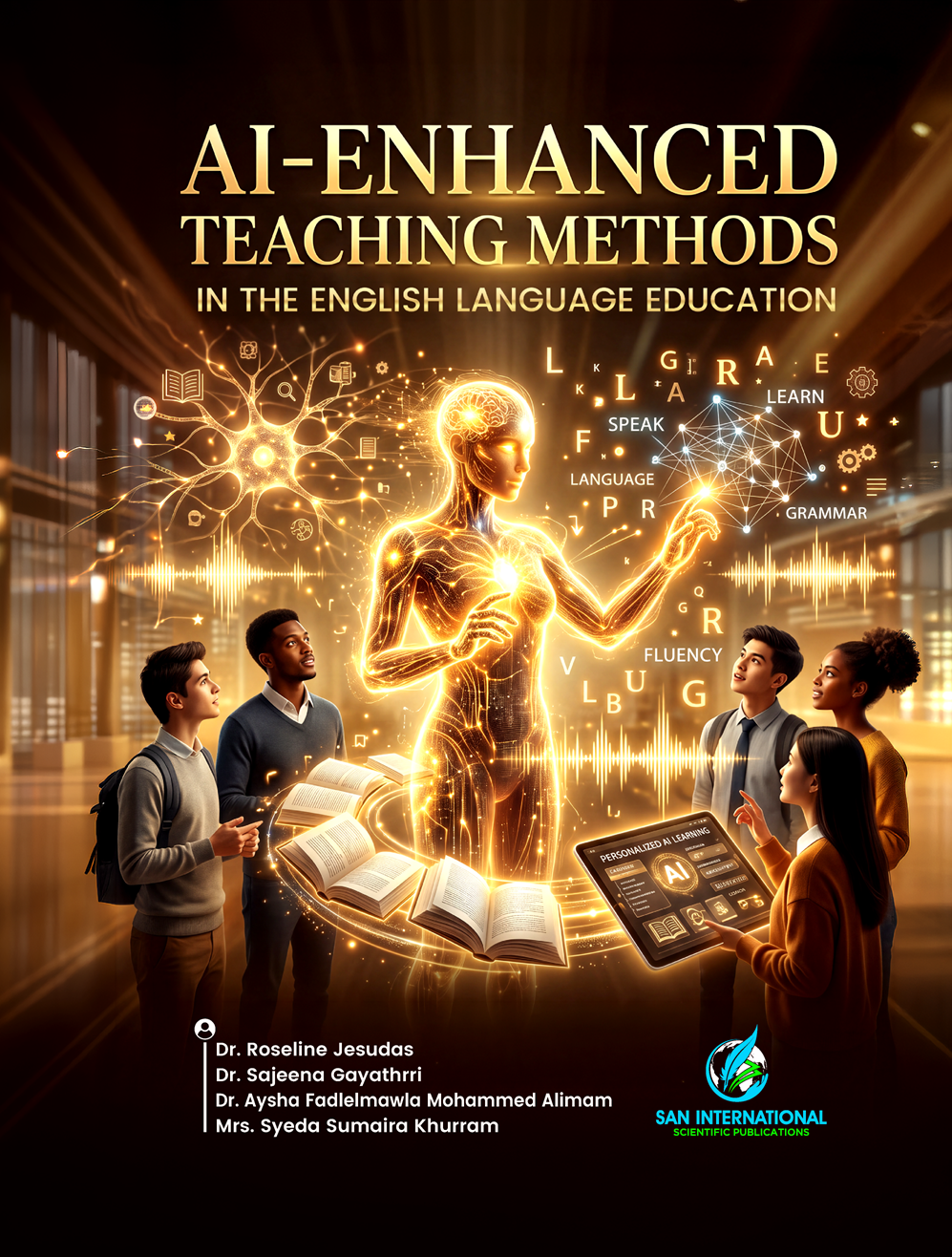
AI-Enhanced Teaching Methods in the English Language Education
Authors: Dr. Roseline Jesudas, Dr. Sajeena Gayathrri, Dr. Aysha Fadlelmawla Mohammed Alimam, and Mrs. Syeda Sumaira Khurram
ISBN: 978-81-69857-26-0
DOI: https://doi.org/10.59646/764
Date of Publication: December 04, 2026
Cite this book: Roseline J, Sajeena G, Aysha FMA, and Syeda SK, (2026), AI-Enhanced Teaching Methods in the English Language Education, San International Scientific Publications, ISBN: 978-81-69857-26-0, DOI: https://doi.org/10.59646/764
Preface
Artificial Intelligence (AI) has emerged as one of the most transformative technologies of the twenty-first century, significantly influencing the way education is designed, delivered, and experienced. In the field of English Language Teaching (ELT), AI has introduced innovative opportunities to enhance teaching effectiveness, personalize learning, improve learner engagement, and support continuous assessment. Intelligent technologies such as chatbots, speech recognition systems, adaptive learning platforms, automated writing assistants, and learning analytics are enabling educators to create dynamic, interactive, and learner-centered classrooms. As English continues to serve as the global language of communication, higher education, research, and professional development, it has become essential for teachers to integrate AI-driven pedagogical practices that prepare learners for an increasingly digital and interconnected world.
AI-Enhanced Teaching Methods in English Language Education has been developed to provide a comprehensive understanding of the integration of Artificial Intelligence into English language teaching and learning. The book is intended for undergraduate and postgraduate students, teacher educators, researchers, practicing teachers, curriculum designers, and educational professionals who seek to understand both the theoretical foundations and practical applications of AI in ELT. It emphasizes that AI should be viewed not as a replacement for teachers, but as an intelligent educational partner that supports personalized instruction, enhances classroom interaction, facilitates timely feedback, and enables evidence-based teaching practices. The book is systematically organized into ten chapters that cover the complete spectrum of AI-enabled English language education. It begins with the foundations of Artificial Intelligence in education, followed by the principles and methodologies of English Language Teaching. Subsequent chapters explore AI-powered language learning tools, conversational agents, speech recognition systems, intelligent writing assistants, adaptive learning platforms, and learning management systems. The book also demonstrates how AI can effectively support the development of listening, speaking, reading, writing, grammar, and vocabulary skills through personalized and interactive learning experiences.
In addition, the text discusses instructional design, curriculum integration, blended and flipped learning models, AI-assisted lesson planning, learning analytics, and content creation. Dedicated chapters examine AI-based assessment methods, adaptive testing, continuous feedback systems, and data-driven evaluation strategies while highlighting the importance of maintaining fairness, transparency, and professional judgment in educational assessment. The book also emphasizes inclusive education by illustrating how AI can support diverse learners, multilingual classrooms, and students with varying learning needs. Recognizing the evolving role of educators, the book highlights the importance of digital pedagogy, continuous professional development, classroom management in AI-enabled environments, and reflective teaching practices. It also addresses critical issues such as ethics, data privacy, algorithmic bias, academic integrity, responsible AI usage, and learner well-being. The concluding chapter explores emerging technologies, including generative AI, intelligent tutoring systems, virtual learning environments, and future trends that are expected to shape the next generation of English language education.
It is hoped that this book will serve as a valuable academic resource that equips educators and learners with the knowledge, skills, and confidence required to integrate Artificial Intelligence effectively and responsibly into English language education. By combining sound pedagogical principles with innovative AI technologies, this book aims to inspire meaningful teaching practices, foster lifelong learning, and contribute to the advancement of quality English language education in the digital era.