
AI-Driven Precision Agriculture: A Systems Approach from Soil Health to Sustainable Harvest
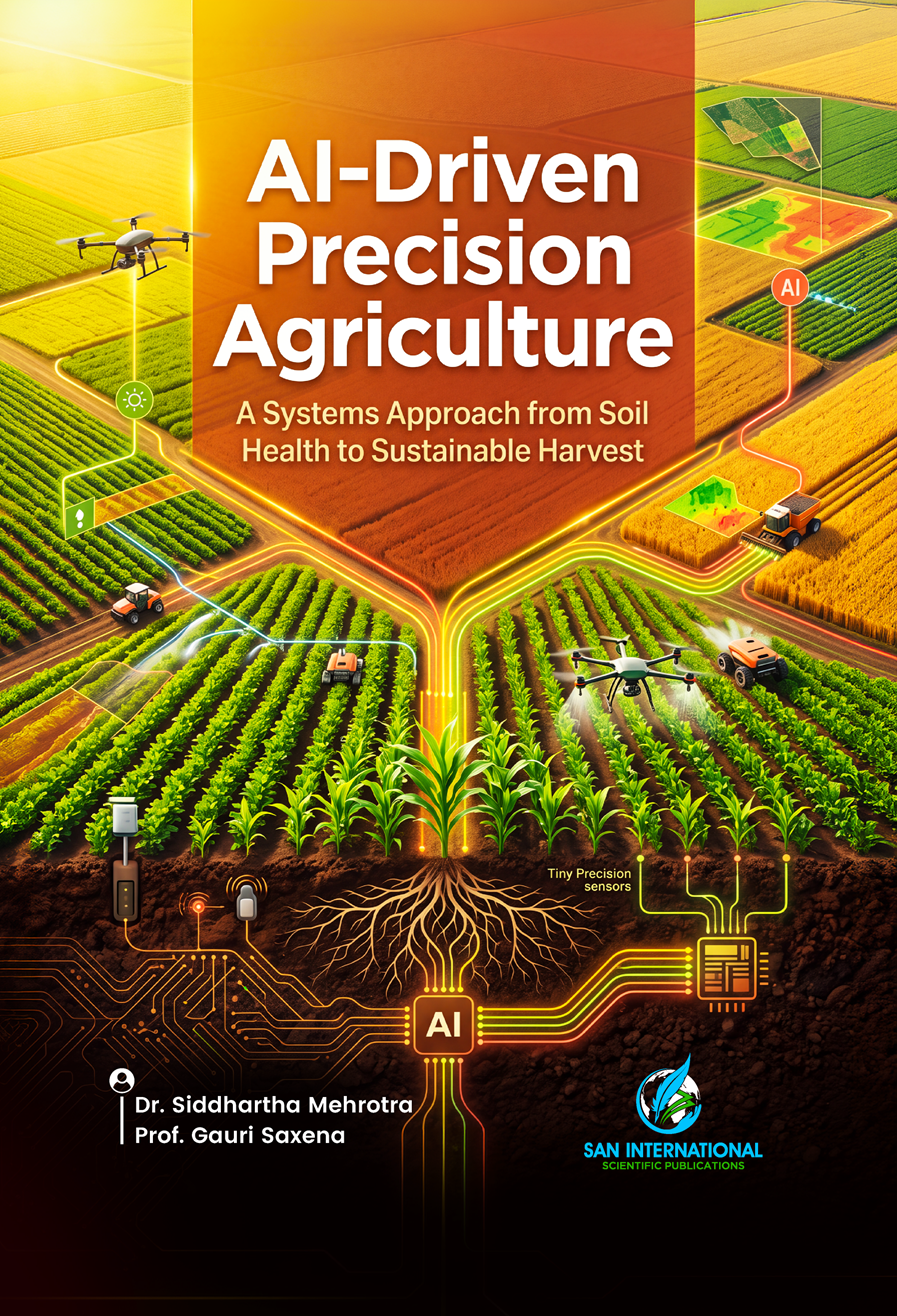
AI-Driven Precision Agriculture: A Systems Approach from Soil Health to Sustainable Harvest
Authors: Dr. Siddhartha Mehrotra, and Prof. Gauri Saxena
ISBN: 978-81-69857-51-2
DOI: https://doi.org/10.59646/798
Date of Publication: August 20, 2026
Cite this book: Siddhartha M, and Gauri S, (2026), AI-Driven Precision Agriculture: A Systems Approach from Soil Health to Sustainable Harvest, San International Scientific Publications, ISBN: 978-81-69857-51-2, DOI: https://doi.org/10.59646/798
Preface
AI-Driven Precision Agriculture: A Systems Approach from Soil Health to Sustainable Harvest presents a comprehensive exploration of how artificial intelligence, data science, Internet of Things (IoT), remote sensing, robotics, computer vision, and intelligent automation are transforming modern agriculture into a data-driven and increasingly autonomous ecosystem. Agriculture is undergoing a fundamental transition from traditional and mechanized practices toward precision, smart, and AI-driven farming, where decisions concerning soil, water, crops, energy, pests, harvesting, storage, and supply chains can be supported by real-time data and predictive intelligence. This book is designed to provide a systems-oriented understanding of this transformation, connecting individual technologies with the broader agricultural processes required to achieve productivity, resource efficiency, resilience, and sustainable food production.
The book begins with the foundations of smart agriculture and AI integration, introducing the evolution from conventional farming to precision and intelligent agricultural systems. It examines digital agriculture architectures involving sensors, connectivity, cloud platforms, analytics, and AI pipelines, while also addressing the role of IoT, drones, robotics, machine vision, and automation. The subsequent focus on soil intelligence establishes the importance of soil as the foundation of agricultural productivity. AI-based soil classification, fertility prediction, nutrient mapping, soil-health monitoring, precision irrigation, GIS, remote sensing, carbon sequestration modeling, and site-specific resource management are explored to demonstrate how intelligent systems can support sustainable soil and water utilization.
The book then progresses from soil to crop selection, sowing, and crop-growth monitoring, emphasizing the application of deep learning, computer vision, climate analytics, reinforcement learning, digital twins, and AI-enabled phenotyping. Advanced approaches for seed placement, growth-stage recognition, canopy analysis, weed identification, disease detection, and pest monitoring illustrate how AI can continuously interpret crop conditions and support timely interventions. Particular attention is given to UAV imagery, hyperspectral imaging, convolutional neural networks, and time-series models, which enable increasingly precise observation of agricultural environments.
A major component of the book addresses intelligent irrigation, fertilization, and energy management. Neural-network-based evapotranspiration estimation, predictive and fuzzy control, sensor-driven irrigation, fertigation automation, groundwater prediction, pump scheduling, renewable-energy integration, and smart water networks are presented as interconnected components of resource-efficient farming. The integration of IoT and machine learning for real-time soil–plant–atmosphere monitoring further demonstrates how agricultural operations can evolve toward closed-loop decision-making systems in which sensing, prediction, control, and optimization operate continuously.
The discussion subsequently extends to agricultural drones, robotics, and automation. UAV-based imaging and spraying, swarm robotics, autonomous tractors and harvesters, robotic fruit picking, multi-sensor perception, obstacle avoidance, livestock monitoring, edge computing, and cloud–edge fleet management illustrate the growing role of autonomous machines in agricultural production. The book also examines predictive analytics and risk management through AI-based yield forecasting, spatiotemporal modeling, climate-risk assessment, crop insurance analytics, market intelligence, blockchain-enabled traceability, early-warning systems, and explainable AI. These technologies demonstrate how intelligent agriculture can move beyond productivity optimization toward proactive management of uncertainty and climate-related risks.
Finally, the book follows agricultural intelligence beyond the field into post-harvest processing, supply-chain management, and agri-logistics. AI-based quality grading, smart packaging, shelf-life prediction, robotic sorting, cold-chain automation, warehouse management, route optimization, predictive maintenance, digital marketplaces, blockchain traceability, and decentralized market models are considered as essential elements of an integrated farm-to-fork ecosystem. Real-world case studies involving platforms and technologies such as Microsoft FarmBeats, IBM Watson Decision Platform for Agriculture, IBM Food Trust, John Deere See & Spray™, and edge-enabled smart irrigation provide practical perspectives on the implementation of these concepts.
Overall, this book is intended for students, researchers, agricultural professionals, engineers, data scientists, technology developers, policymakers, and practitioners seeking a technically grounded understanding of AI-enabled agriculture. Rather than treating artificial intelligence as an isolated technology, the book approaches precision agriculture as an interconnected system in which soil intelligence, crop management, water and energy optimization, autonomous machinery, predictive analytics, and supply-chain intelligence collectively contribute to sustainable agricultural production. It aims to provide a strong foundation for understanding how intelligent technologies can transform agricultural decision-making from reactive practices into predictive, adaptive, and increasingly autonomous systems, ultimately supporting the transition from healthier soils to smarter cultivation and more sustainable harvests.