AI-Driven Manufacturing: Revolutionizing Mechanical Design and Production
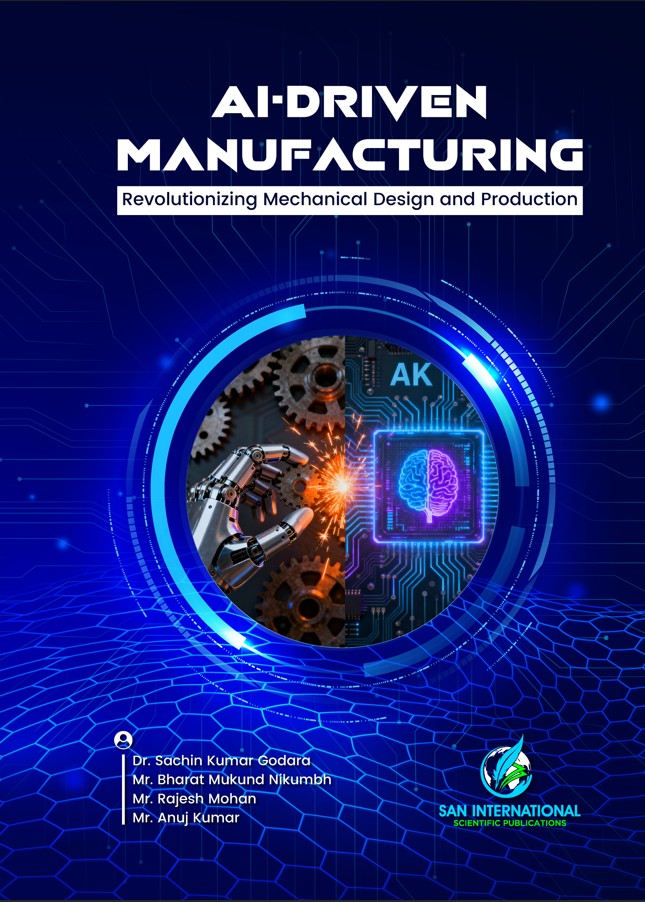
AI-Driven Manufacturing: Revolutionizing Mechanical Design and Production
Authors: Mr. Sachin Kumar Godara, Mr. Bharat Mukund Nikumbh, Mr. Rajesh Mohan and Mr. Anuj Kumar
ISBN: 978-81-993810-5-6
DOI: https://doi.org/10.59646/488
Date of Publication: September 25, 2025
About the Book:
The global manufacturing landscape is undergoing a paradigm shift—driven by the convergence of Artificial Intelligence (AI), automation, and advanced digital technologies. Once defined by mechanical precision and human craftsmanship, manufacturing has evolved into an intelligent, adaptive, and data-driven ecosystem. The book “AI-Driven Manufacturing: Revolutionizing Mechanical Design and Production” is written to explore this transformation in depth, tracing the impact of AI across the full spectrum of mechanical engineering, design, and production processes.
Artificial Intelligence, once a theoretical concept confined to computer science laboratories, now forms the backbone of modern manufacturing. From predictive analytics and generative design to robotic automation and digital twins, AI technologies are redefining how machines are built, how materials are selected, how operations are optimized, and how decisions are made. Manufacturers worldwide are leveraging AI to reduce downtime, minimize waste, improve precision, and achieve unparalleled efficiency in production. The traditional boundaries between design, engineering, and manufacturing are blurring, giving rise to a new era of intelligent manufacturing systems—systems that learn, adapt, and evolve.
This book is designed to serve as a comprehensive guide for students, researchers, industry professionals, and decision-makers seeking to understand and apply AI in the manufacturing domain. It provides a balanced blend of theory, technology, and industrial applications, organized into six in-depth units.
Unit 1, “Introduction to AI in Manufacturing,” lays the foundation by explaining the fundamental principles of Artificial Intelligence, its historical development, and its integration into industrial settings. It introduces readers to key technologies such as machine learning, computer vision, and robotics, while also addressing the challenges and ethical considerations in adopting AI for manufacturing.
Unit 2, “AI Technologies in Manufacturing,” delves into the core AI technologies that empower smart factories. It covers topics such as machine learning, deep learning, reinforcement learning, cognitive computing, and computer vision, along with their applications in process optimization, real-time decision-making, and automation. This unit also discusses the role of digital twins, simulation, and robotic process automation in achieving high levels of productivity and quality.
Unit 3, “AI in Mechanical Design Optimization,” explores how AI enhances mechanical design processes, from material selection to structural optimization. The chapter discusses AI-driven CAD/CAM integration, generative and sustainable design principles, optimization algorithms, and design validation using AI. It highlights how AI accelerates prototyping, improves cost estimation, and enables engineers to achieve optimal trade-offs between performance, cost, and sustainability.
Unit 4, “AI for Predictive Maintenance and Quality Control,” addresses one of the most transformative aspects of Industry 4.0—predictive maintenance. Through AI-powered fault detection, diagnostics, and anomaly detection, manufacturers can predict and prevent equipment failures, ensuring continuous production. This unit also explores the integration of AI in statistical process control, Six Sigma, and digital twin-based quality assurance systems.
Unit 5, “Robotics and Automation in AI-Driven Manufacturing,” examines the interplay between AI and robotics in revolutionizing industrial automation. From autonomous mobile robots and collaborative robots (cobots) to swarm robotics and advanced gripping technologies, the unit illustrates how intelligent robotic systems are reshaping material handling, assembly, welding, and fabrication. Human-robot interaction, safety standards, and machine vision-based navigation systems are also discussed in detail.
Unit 6, “AI in Production Planning and Supply Chain Management,” extends the discussion to the broader production ecosystem. It explains how AI enhances production scheduling, resource allocation, demand forecasting, and energy management. It also explores advanced concepts such as blockchain-based supply chain transparency, dynamic pricing, and adaptive manufacturing systems, demonstrating how AI fosters global competitiveness through intelligent decision-making and end-to-end visibility.
Throughout the book, emphasis is placed on practical applications, real-world case studies, and emerging research directions. Readers will gain insights into how AI not only improves efficiency and precision but also enables sustainable and resilient manufacturing systems that can adapt to disruptions and market fluctuations.
This text is designed to bridge the gap between mechanical engineering and artificial intelligence, providing a multidisciplinary understanding of how the two domains converge to create smarter factories and innovative design solutions. Whether the reader is an engineering student seeking to understand Industry 4.0 concepts, a researcher exploring AI-based optimization, or a professional aiming to implement AI tools in production environments, this book provides the theoretical depth and practical context needed for meaningful application.
Ultimately, “AI-Driven Manufacturing: Revolutionizing Mechanical Design and Production” envisions a future where machines think, learn, and collaborate with humans—creating manufacturing systems that are intelligent, efficient, adaptive, and sustainable. As industries advance toward Industry 5.0, where human creativity and AI intelligence coexist, this book serves as both a foundation and a roadmap for understanding the transformative power of AI in shaping the factories of the future.