Advanced Materials Science: Fundamentals, Synthesis & Characterization
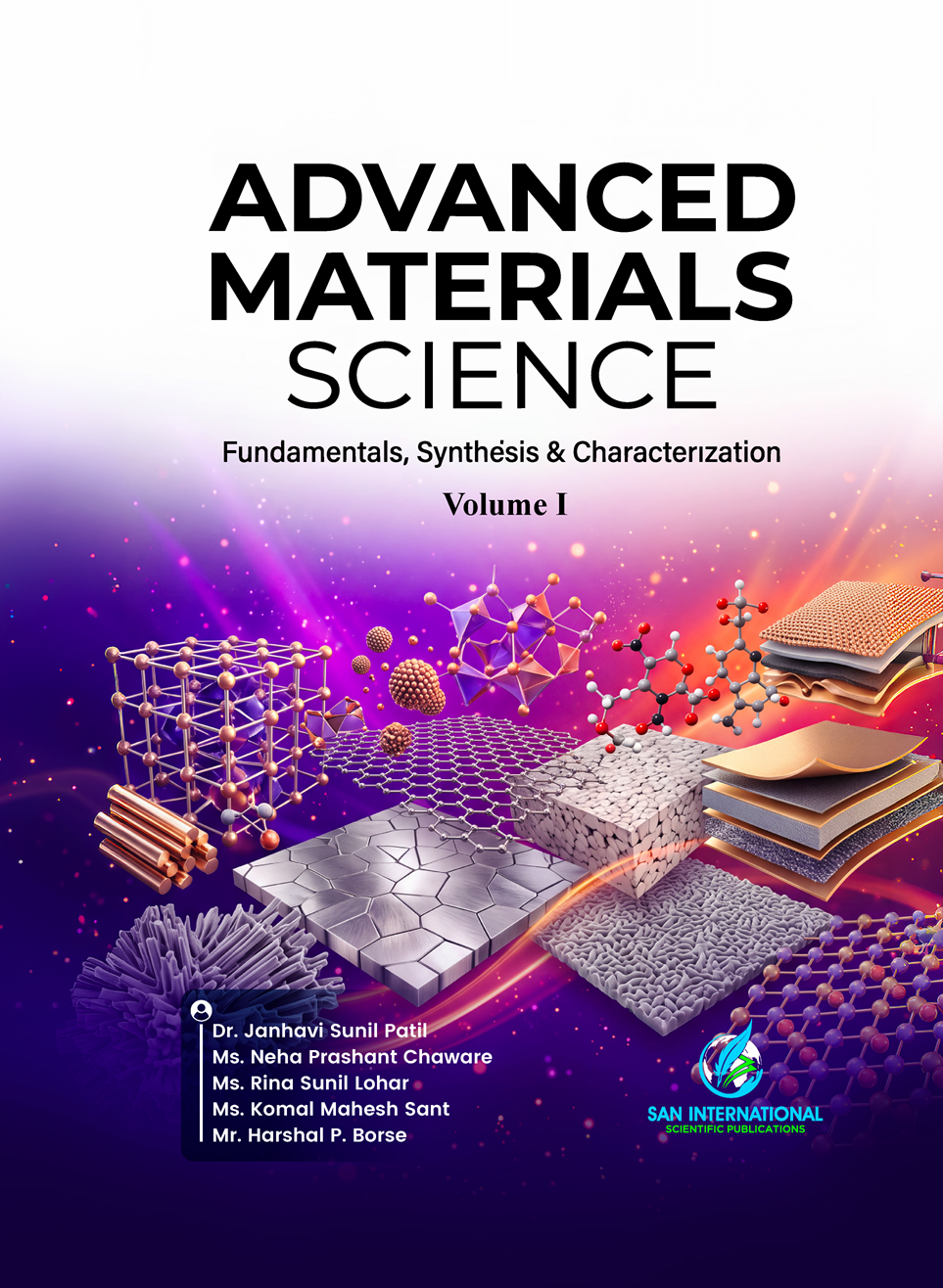
Advanced Materials Science: Fundamentals, Synthesis & Characterization
Authors: Dr. Janhavi Sunil Patil, Ms. Neha Prashant Chaware, Ms. Rina Sunil Lohar, Ms. Komal Mahesh Sant, and Mr. Harshal P. Borse
ISBN: 978-81-69857-61-1
DOI: https://doi.org/10.59646/801
Date of Publication: August 31, 2026
Cite this book: Janhavi SP, Neha PC, Rina SL, Komal MS, and Harshal PB, (2026), Advanced Materials Science: Fundamentals, Synthesis & Characterization, San International Scientific Publications, ISBN: 978-81-69857-61-1, DOI: https://doi.org/10.59646/801
Preface
Materials science is a fundamental and rapidly evolving field that provides the scientific foundation for the development of modern technologies, engineering systems, and advanced industrial applications. The performance, reliability, functionality, and sustainability of almost every technological product depend strongly on the selection, design, processing, and characterization of materials. From conventional metals, ceramics, polymers, and composites to semiconductors, nanomaterials, smart materials, biomaterials, quantum materials, thin films, and advanced functional materials, the field has expanded considerably to address the increasingly complex requirements of contemporary society. Advanced Materials Science: Fundamentals, Synthesis & Characterization – Simplified-Language Syllabus (Volume 1) has been developed to provide a structured and accessible introduction to these important concepts while maintaining a strong connection between fundamental principles and modern materials technologies.
The book begins with the fundamentals of materials science, introducing its meaning, scope, importance, interdisciplinary nature, and historical evolution from the Stone Age and Bronze Age to the modern era of nanomaterials and quantum materials. Particular attention is given to the role of materials science in sustainable development, energy efficiency, recycling, waste reduction, environmental protection, and sustainable manufacturing. The discussion then progresses to the classification of materials, covering metals and alloys, ceramics, polymers, composites, semiconductors, nanomaterials, smart and stimuli-responsive materials, biomaterials, bio-inspired materials, quantum materials, thick films, and thin films. This broad classification helps readers understand how different material families are related to their structure, processing methods, and functional properties.
A major foundation of materials science is the relationship between atomic arrangement and material behavior. Accordingly, the book provides detailed coverage of crystal structures and defects, including the seven crystal systems, fourteen Bravais lattices, Miller indices, Miller–Bravais indices, unit cells, atomic packing factors, coordination numbers, and close-packed structures. Point defects, dislocations, planar interfaces, volume defects, quasicrystals, and amorphous structures are also introduced, together with their influence on mechanical, electrical, and optical properties. The treatment of bonding in materials further explains ionic, covalent, metallic, van der Waals, and hydrogen bonding, as well as mixed bonding characteristics, band theory, Fermi-level concepts, density of states, and quantum confinement.
The book subsequently develops the thermodynamic and structural principles required to understand material transformations through phase diagrams and thermodynamics. Gibbs phase rule, binary and ternary phase diagrams, free-energy–composition relationships, miscibility gaps, solidification, dendritic growth, precipitation and age hardening, spinodal decomposition, the iron–carbon phase diagram, and steel microstructures are presented in a systematic manner. These concepts establish an essential link between composition, processing conditions, microstructure, and final material performance.
The overview of material properties introduces mechanical, electrical, optical, magnetic, thermal, and chemical behavior. Elasticity, plasticity, hardness, toughness, fatigue, creep, electrical conductivity, dielectric response, piezoelectricity, refractive index, photoluminescence, magnetic ordering, thermal conductivity, thermal expansion, corrosion resistance, oxidation, and catalytic activity are considered as important parameters for material selection and engineering design. The book then moves from understanding materials to producing them through solid-state processing, including solid-state reactions, mechanical alloying, high-energy ball milling, spark plasma sintering, hot pressing, hot isostatic pressing, cold isostatic pressing, reactive and flash sintering, extrusion, and forging.
Modern materials synthesis is explored through wet chemical methods, including sol–gel processing, co-precipitation, hydrothermal and solvothermal synthesis, chemical reduction, microemulsion and reverse-micelle methods, and electrochemical synthesis. These approaches are particularly relevant for producing controlled powders, nanoparticles, functional materials, and advanced ceramic systems. The book also examines solution-based thin-film deposition, covering chemical bath deposition, SILAR, spray pyrolysis, spin coating, dip coating, screen and stencil printing, doctor-blade processing, inkjet printing, aerosol jet printing, and electrodeposition.
The later sections introduce vapor-phase deposition and nanomaterial synthesis, providing an overview of PVD, evaporation, sputtering, pulsed laser deposition, molecular beam epitaxy, cathodic arc deposition, CVD, plasma-enhanced CVD, MOCVD, atomic layer deposition, and the growth of graphene, transition-metal dichalcogenides, and other two-dimensional materials. Nanomaterial synthesis is further expanded through electrospinning, microwave-assisted synthesis, sonochemical synthesis, green synthesis, flame spray pyrolysis, laser ablation in liquids, arc discharge, and top-down approaches such as lithography, focused ion beam nanomachining, and nanoimprint lithography.
Written in a simplified and progressive manner, this volume is intended to make advanced materials concepts easier to understand without losing their scientific and engineering significance. It is designed as a useful academic resource for students, researchers, educators, engineers, and professionals seeking a strong foundation in modern materials science. By connecting structure, bonding, thermodynamics, properties, synthesis, deposition, nanotechnology, and advanced processing, Volume 1 establishes the essential knowledge required to understand how materials are designed and transformed for next-generation technological applications.