Advanced Materials Science: Devices, Applications & Research Methodology
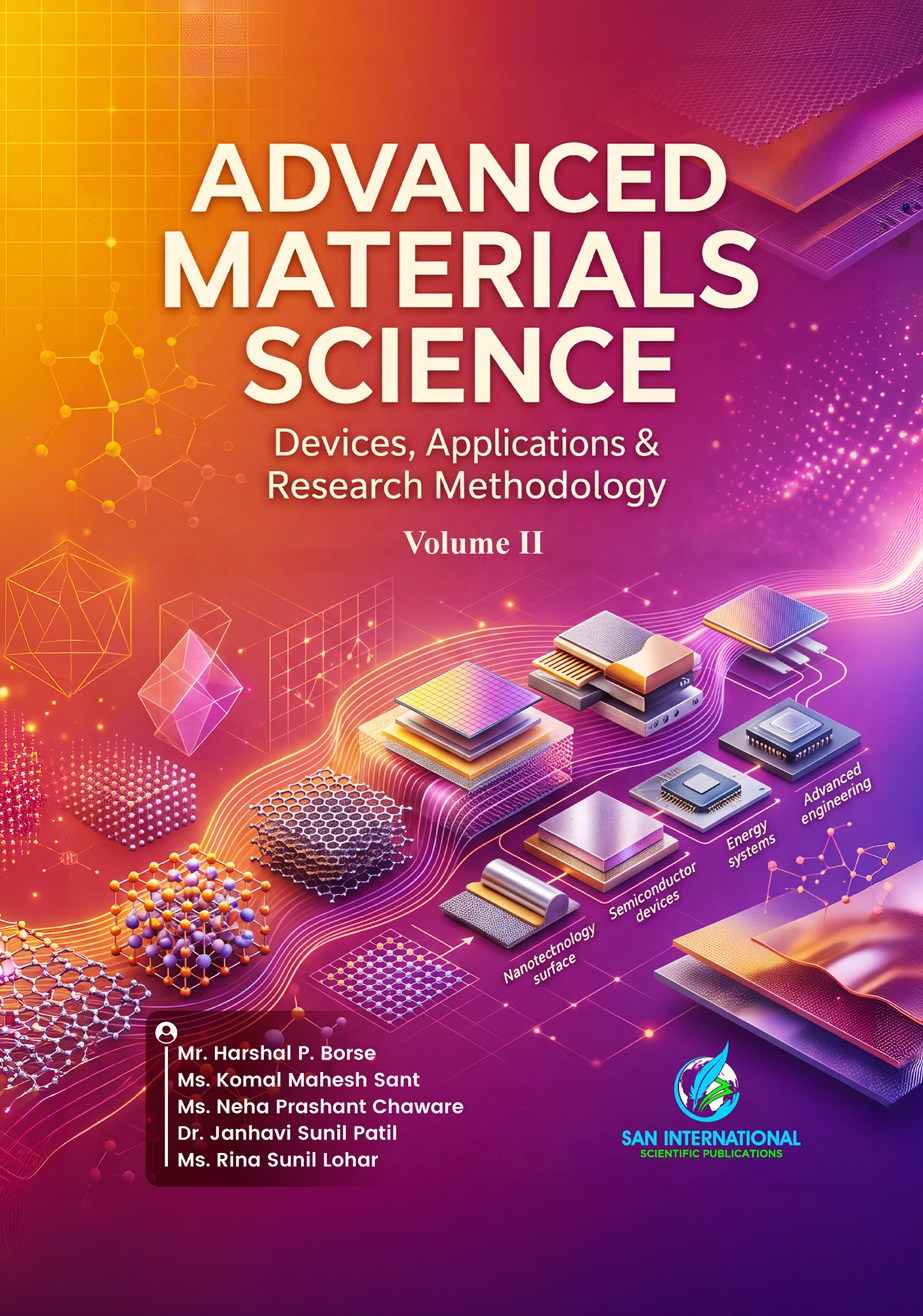
Advanced Materials Science: Devices, Applications & Research Methodology
Authors: Mr. Harshal P. Borse, Ms. Komal Mahesh Sant, Ms. Neha Prashant Chaware, Dr. Janhavi Sunil Patil, and Ms. Rina Sunil Lohar
ISBN: 978-81-69857-55-0
DOI: https://doi.org/10.59646/807
Date of Publication: August 31, 2026
Cite this book: Harshal PB, Komal MS, Neha PC, Janhavi SP, and Rina SL, (2026), Advanced Materials Science: Devices, Applications & Research Methodology, San International Scientific Publications, ISBN: 978-81-69857-55-0, DOI: https://doi.org/10.59646/807
Preface
Materials science has become one of the most important foundations of modern science and engineering, providing the knowledge required to design, synthesize, process, characterize, and apply materials with carefully controlled structural and functional properties. The rapid development of renewable energy, energy storage, electronics, sensing, photonics, nanotechnology, and advanced manufacturing has created a growing demand for materials that are not only stronger, lighter, and more durable, but also capable of performing specialized electrical, optical, magnetic, thermal, catalytic, and electrochemical functions. Advanced Materials Science: Fundamentals, Synthesis & Characterization — Simplified-Language Syllabus has been developed to introduce these concepts in a structured and accessible manner, connecting fundamental materials science with advanced materials and their emerging technological applications.
The book begins with semiconductor physics fundamentals, establishing the principles needed to understand modern electronic and energy-conversion materials. Energy-band formation, direct and indirect bandgaps, carrier statistics, intrinsic and extrinsic semiconductors, carrier transport, p–n junctions, heterojunctions, metal–semiconductor contacts, recombination mechanisms, and defect physics provide the foundation for understanding semiconductor-based devices. These topics demonstrate how atomic structure, electronic states, interfaces, defects, and carrier behavior determine the performance of functional materials. A significant part of the book is devoted to thin-film solar cells and photovoltaic materials, reflecting the central role of advanced materials in the transition toward sustainable energy technologies. The discussion progresses from the solar spectrum and fundamental photovoltaic limits to solar-cell performance parameters, quantum efficiency, first- and second-generation solar cells, CdTe, CIGS, amorphous and microcrystalline silicon, kesterite materials, buffer layers, transparent conducting oxides, perovskite solar cells, organic photovoltaics, quantum-dot solar cells, tandem and multi-junction devices, and emerging third-generation concepts. The book also addresses thin-film module technology, encapsulation, stability, and degradation mechanisms, thereby connecting material properties with practical device reliability. Understanding advanced materials requires accurate and meaningful characterization techniques. Accordingly, the book presents solar-cell characterization through J–V analysis, quantum-efficiency measurements, light-intensity dependence, temperature-dependent measurements, electroluminescence imaging, photoluminescence imaging, light-beam-induced current mapping, and accelerated lifetime testing. These techniques help readers understand how electrical, optical, structural, and defect-related information can be extracted from materials and devices and how characterization results can guide material optimization and process development.
The book further explores materials for electrochemical energy storage, covering lithium-ion and beyond-lithium batteries, cathode and anode materials, solid electrolytes, solid-state batteries, sodium-ion batteries, lithium–sulfur and lithium–air systems, zinc-ion and potassium-ion batteries, and multivalent battery technologies. The treatment emphasizes the relationship between electrochemical reactions, crystal structures, interfaces, transport mechanisms, mechanical degradation, and long-term performance. This is complemented by a detailed discussion of supercapacitors and hybrid energy-storage systems, including electric double-layer capacitors, pseudocapacitors, hybrid capacitors, Ragone plots, and advanced electrolyte engineering.
Energy conversion is extended to fuel cells, thermoelectric materials, photocatalysis, and hydrogen generation. Proton exchange membrane fuel cells and solid oxide fuel cells are introduced along with their construction, electrochemistry, electrolyte materials, and mixed ionic-electronic conductors. Thermoelectric materials are examined through concepts such as the Seebeck coefficient, electrical conductivity, phonon-glass electron-crystal behavior, figure of merit, and nanostructuring strategies. Photocatalytic water splitting, heterojunction photocatalysts, hydrogen evolution and oxygen evolution reactions, carbon-dioxide reduction, and electrocatalysis are also discussed, highlighting the importance of materials design in clean-energy technologies.
The book also introduces a wide range of functional materials, including dielectric, ferroelectric, piezoelectric, magnetic, magnetocaloric, shape-memory, phase-change, metamaterial, phononic, topological, optical, and photonic materials. These materials exhibit specialized responses to electrical, magnetic, thermal, mechanical, and electromagnetic stimuli and therefore have applications extending from actuators and sensors to energy harvesting, communication, thermal management, advanced optics, and next-generation electronic systems. Particular attention is given to lead-free piezoelectrics, relaxor ferroelectrics, multiferroics, soft and hard magnetic materials, spintronics, magnetic thin films, shape-memory systems, metamaterials, photonic crystals, quantum materials, and luminescent materials. Another important dimension of the book is materials-based sensing and intelligent detection. Gas and chemical sensors are examined through metal-oxide semiconductor sensors, chemiresistive systems, electrochemical gas sensors, surface acoustic wave sensors, optical-fiber sensors, and surface plasmon resonance biosensors. Pressure, temperature, and strain sensing are further explored through piezoresistive and capacitive sensors, thermocouples, thermistors, resistance temperature detectors, pyroelectric sensors, and flexible and wearable strain-sensing materials. These topics demonstrate how advanced materials can transform small physical or chemical changes into measurable electrical or optical signals.
The syllabus is intentionally presented in a simplified-language format so that complex scientific concepts can be understood progressively by learners from different academic backgrounds. At the same time, important technical terminology, physical mechanisms, device architectures, and engineering concepts are retained to ensure academic relevance and technical depth. The organization moves from fundamental semiconductor physics and photovoltaic materials toward energy storage, energy conversion, functional materials, photonics, and sensing technologies, allowing readers to gradually develop an integrated understanding of advanced materials and their applications.