A Textbook on Internal Combustion Engine, Fuel & Lubrication (ICEFL)
A Textbook on Internal Combustion Engine, Fuel & Lubrication (ICEFL)
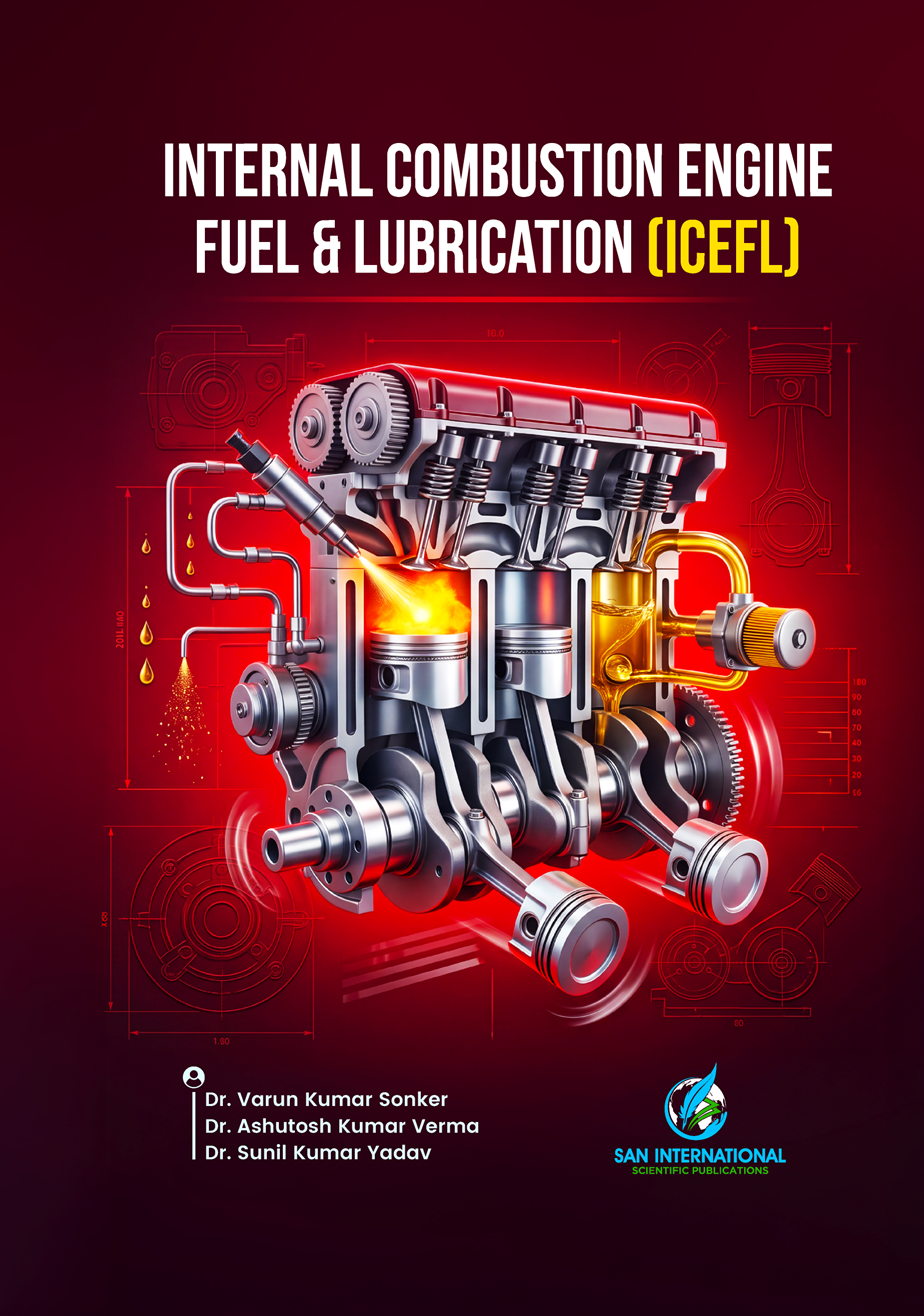
Authors: Dr. Varun Kumar Sonker, Dr. Ashutosh Kumar Verma, Dr. Sunil Kumar Yadav
ISBN: 978-81-17787-00-7
DOI: https://doi.org/10.59646/857
Date of Publication: October 21, 2026
Preface
The book Internal Combustion Engine, Fuel & Lubrication (ICEFL) provides a comprehensive and technically oriented introduction to the principles, design, operation, performance, and maintenance of internal combustion engines, with particular emphasis on thermodynamic cycles, combustion processes, fuel supply systems, emission control, cooling, lubrication, and emerging engine technologies. Internal combustion engines continue to play a significant role in transportation, agriculture, power generation, and industrial applications, making their efficient and reliable operation essential to modern engineering practice. A thorough understanding of engine thermodynamics, fuel characteristics, combustion behaviour, and lubrication mechanisms is therefore fundamental to the development of engines that deliver improved performance, enhanced durability, reduced fuel consumption, and lower environmental impact. This book systematically examines air-standard cycles, including the Otto, Diesel, and Dual cycles, alongside fuel–air cycles and actual engine cycles, enabling readers to understand the relationship between theoretical efficiency and practical engine performance. It further explores engine testing methods, performance parameters, basic measurement techniques, blow-by measurement, and the testing procedures employed for spark-ignition (SI) and compression-ignition (CI) engines.
The chapters on combustion provide detailed coverage of the stages of combustion in SI and CI engines, flame propagation, ignition delay, factors influencing combustion, abnormal combustion phenomena, and methods for their control. Particular attention is also given to combustion chamber design and the roles of squish, swirl, and tumble in promoting effective air–fuel mixing and improving combustion efficiency. The discussion of fuel supply and injection systems encompasses carburettors, mixture requirements, multi-point fuel injection (MPFI), fuel injection equipment for CI engines, fuel pumps, injectors, injection timing, and scavenging in two-stroke engines. Turbocharging technologies, including variable geometry and wastegate turbochargers, are examined in relation to engine power output, operating efficiency, and exhaust emissions. Recognising the increasing importance of environmental sustainability, the book addresses the sources, formation mechanisms, and effects of major engine pollutants, including nitrogen oxides, hydrocarbons, carbon monoxide, and particulate matter. It also explains emission reduction technologies such as catalytic converters, particulate traps, selective catalytic reduction (SCR), and diesel oxidation catalysts (DOC). The treatment of fuels extends from conventional petrol and diesel to gaseous and alternative fuels, including liquefied petroleum gas (LPG), compressed natural gas (CNG), biogas, and producer gas, with attention to fuel quality, octane and cetane ratings, additives, and the characteristics that influence engine compatibility and performance. In addition, the book examines engine cooling systems, radiators, cooling fans, frictional losses, lubrication principles, lubrication regimes, lubricating oils, and crankcase ventilation, highlighting their importance in maintaining thermal stability, reducing wear, and extending engine service life.
The principles and operation of magneto, battery, and electronic ignition systems are also discussed, together with ignition timing, spark plugs, and the essential requirements for reliable ignition in SI engines. The concluding discussions introduce contemporary developments such as lean-burn engines, stratified-charge spark-ignition engines, homogeneous-charge spark-ignition engines, and gasoline direct injection (GDI), illustrating the continuing evolution of engine design towards greater efficiency and improved combustion control.
By integrating fundamental theory with practical engineering applications, this book aims to support undergraduate and postgraduate students, faculty members, researchers, automotive engineers, and practising professionals in developing a sound understanding of internal combustion engine technology. The material is organised to facilitate conceptual learning, technical analysis, and the application of engineering principles to real-world engine systems. Ultimately, Internal Combustion Engine, Fuel & Lubrication (ICEFL) seeks to serve as a valuable academic and professional reference for understanding conventional engine technologies while appreciating the engineering developments shaping the future of efficient, reliable, and environmentally responsible power generation.