Physical Chemistry – I, New Syllabus – Bharathidasan University (2022–2023 Onwards)
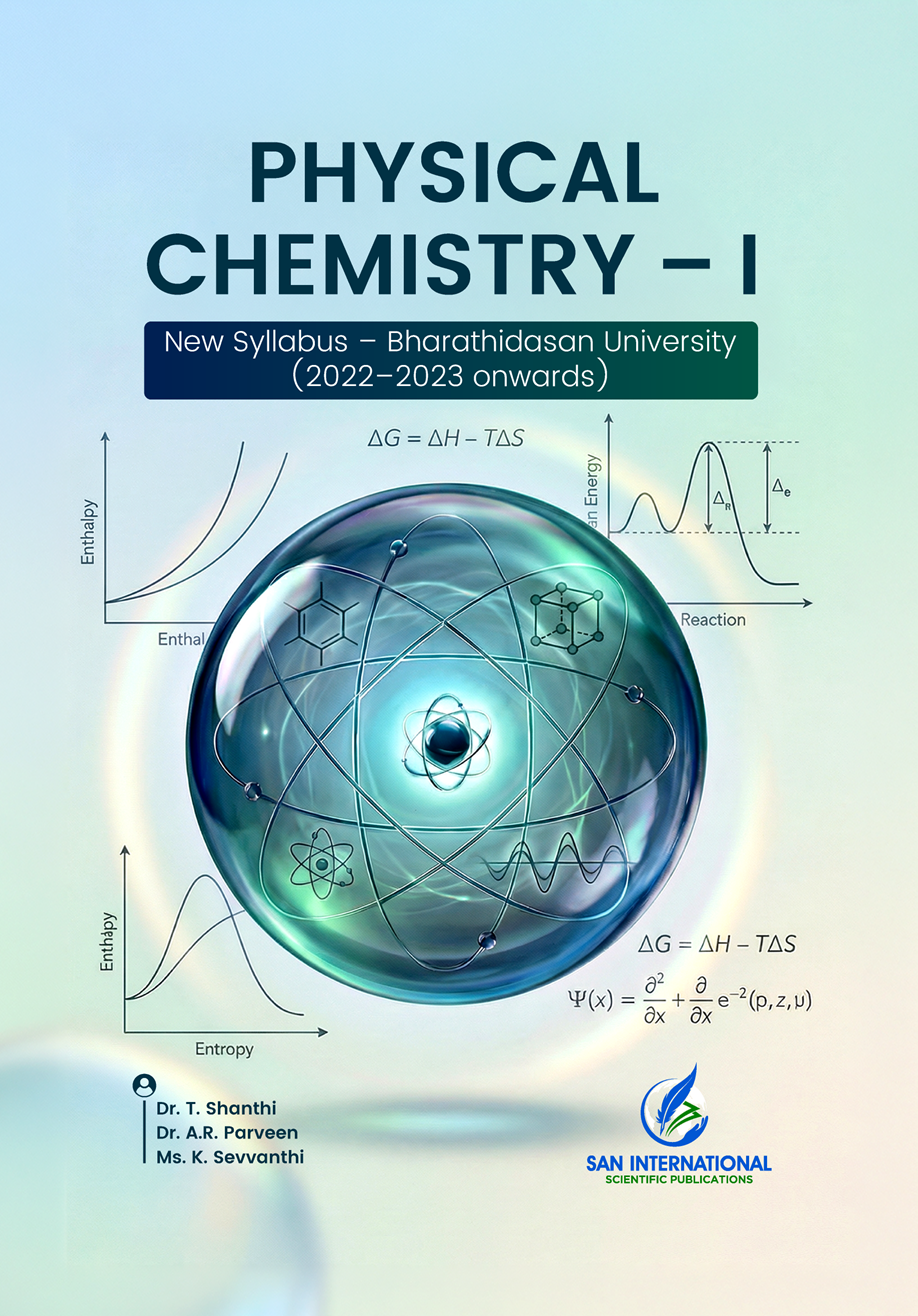
Physical Chemistry – I, New Syllabus – Bharathidasan University (2022–2023 Onwards)
Authors: Dr. T. Shanthi, Dr. A.R. Parveen, and Ms. K. Sevvanthi
ISBN: 978-81-999695-0-6
DOI: https://doi.org/10.59646/613
Date of Publication: March 06, 2026
Cite this book: T. Shanthi, A.R. Parveen, and K. Sevvanthi, (2026), Physical Chemistry – I, San International Scientific Publications,ISBN: 978-81-999695-0-6, DOI: https://doi.org/10.59646/613.
Preface
Physical Chemistry – I is prepared to provide students with a clear, systematic, and comprehensive understanding of the fundamental principles that govern the physical behavior of chemical systems. Physical chemistry forms a crucial bridge between chemistry, physics, and mathematics, enabling students to understand how chemical processes occur, why they occur, and how they can be quantitatively described. This book has been carefully structured to introduce important theoretical concepts in a simple and logical manner, making it suitable for undergraduate students who are beginning their study of advanced chemical principles.
The first unit focuses on Photochemistry and Group Theory, beginning with the basic consequences of light absorption and the Jablonski diagram, which explains various radiative and non-radiative transitions occurring in excited molecules. Concepts such as Lambert–Beer’s law and quantum efficiency are discussed to illustrate how light interacts with matter. The unit also explains different types of photochemical reactions and compares them with thermal reactions, highlighting the unique characteristics of light-induced processes. Important phenomena such as photosensitization, quenching, fluorescence, phosphorescence, and chemiluminescence are included along with an introduction to lasers and their practical applications. In addition, the fundamentals of group theory are introduced with discussions on symmetry elements, symmetry operations, group postulates, and types of groups such as abelian and non-abelian groups, with illustrations using molecules like H₂O, BF₃, and NH₃ and the construction of multiplication tables for symmetry operations.
The second and third units deal with Thermodynamics, one of the most important areas of physical chemistry that explains the energy changes accompanying physical and chemical processes. The second law of thermodynamics is introduced with its necessity and different statements, followed by a detailed discussion of Carnot’s cycle, efficiency of heat engines, Carnot’s theorem, and the thermodynamic scale of temperature. The concept of entropy and its physical significance are explained in relation to pressure, volume, and temperature, along with entropy changes during phase transitions and mixing. The criteria for spontaneity and equilibrium in isolated systems are examined through entropy considerations. Further discussion includes the thermodynamic functions Gibbs free energy and Helmholtz free energy and their variations with pressure, volume, and temperature, together with the Gibbs–Helmholtz equation and its applications. The thermodynamic equations of state, Maxwell’s relations, and the conditions for spontaneity and equilibrium are also presented. The third unit extends thermodynamic principles to chemical equilibria, including the relationship between equilibrium constants and free energy change, the thermodynamic derivation of the law of mass action, and equilibrium constants expressed in terms of pressure and concentration with examples such as NH₃, PCl₅, and CaCO₃ systems. It also provides a thermodynamic interpretation of Le Chatelier’s principle and explains systems of variable composition, partial molar quantities, chemical potential, the Gibbs–Duhem equation, and the variation of chemical potential with temperature, pressure, and mole fraction. Important equations such as Van’t Hoff’s reaction isotherm, Van’t Hoff’s isochore, the Clapeyron equation, and the Clausius–Clapeyron equation are discussed with their applications. The third law of thermodynamics and Nernst heat theorem are also included, along with the concept of residual entropy and the evaluation of absolute entropy from heat capacity data.
The fourth unit deals with Solutions and their thermodynamic behavior. It explains the fundamental laws governing solutions such as Raoult’s law and Henry’s law and distinguishes between ideal and non-ideal solutions. The behavior of completely miscible liquid systems like benzene–toluene is examined, along with deviations from Raoult’s law and the Duhem–Margules equation. The theory of fractional distillation and the concept of azeotropes, illustrated with systems such as HCl–water and ethanol–water, are discussed. The unit also covers partially miscible liquid systems including phenol–water, triethylamine–water, and nicotine–water systems, along with the concepts of lower and upper critical solution temperatures and the effect of impurities. The principles and applications of steam distillation for completely immiscible liquids are explained. In addition, the Nernst distribution law and its derivation are presented. Dilute solutions and their colligative properties such as relative lowering of vapour pressure, osmotic pressure, elevation of boiling point, and depression in freezing point are described, along with their practical application in determining molecular masses by methods such as the Rast method.
The fifth unit discusses Phase Changes and Phase Equilibria, which are essential for understanding the conditions under which different phases of matter coexist. The phase rule is derived and applied to one-component systems such as water and sulphur, including phenomena like supercooling and sublimation. Two-component systems are studied through solid–liquid equilibria and simple eutectic systems such as lead–silver and bismuth–cadmium, including practical applications like the de-silverisation of lead. The formation of compounds with congruent and incongruent melting points is illustrated using systems such as magnesium–zinc and sodium–potassium. The concept of solid solutions is also introduced with examples such as the silver–gold system, along with processes like fractional crystallization and freezing mixtures. Hydrated salt systems such as FeCl₃–H₂O and CuSO₄–H₂O are also included to demonstrate phase behavior in multi-component systems. Overall, this book aims to develop a strong conceptual understanding of the principles of physical chemistry, encouraging analytical thinking and providing students with the theoretical foundation necessary for further study and practical application in chemistry and related scientific fields.