
Molecular Physiology and Functional Biology: An Integrated Systems Perspective
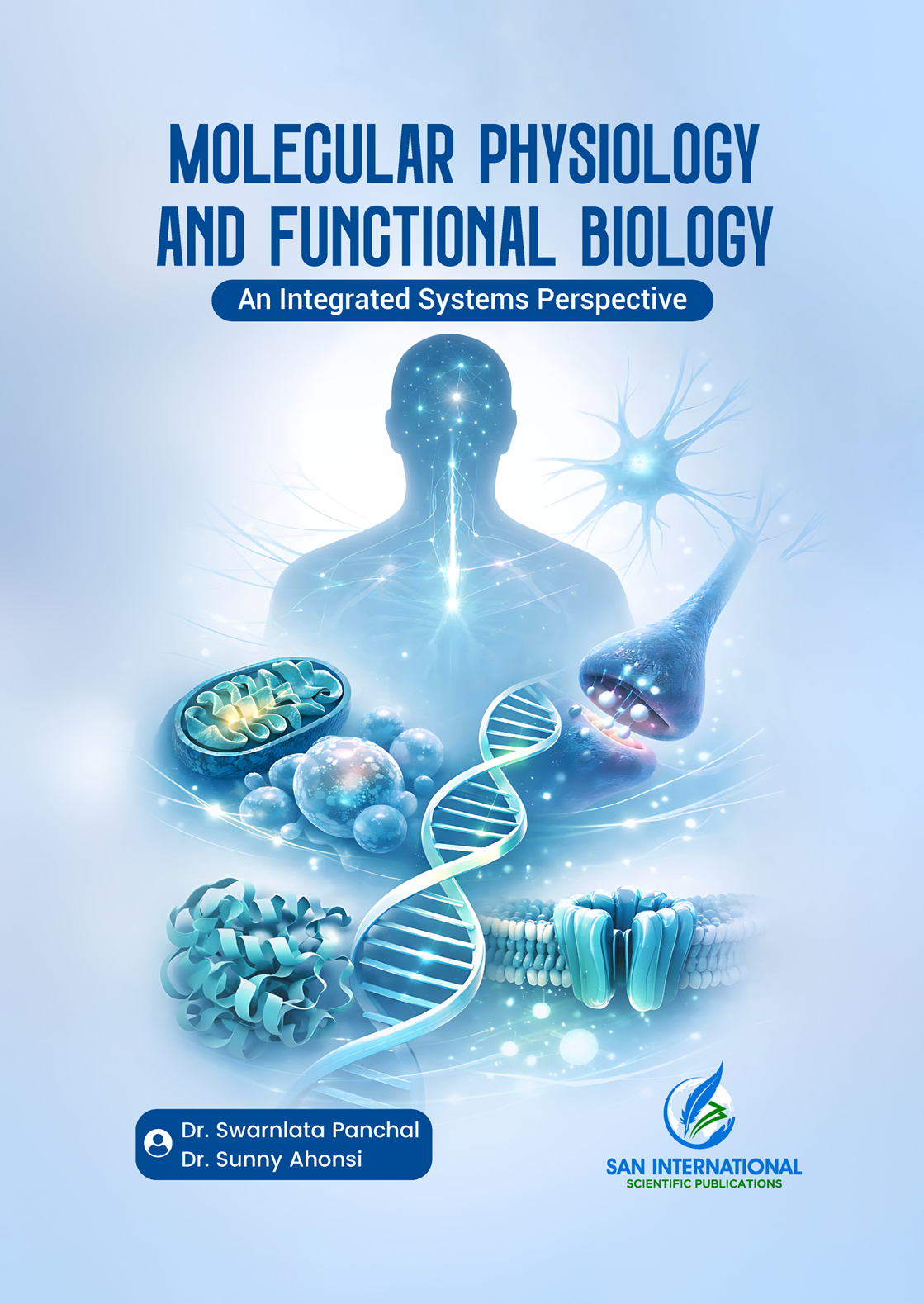
Molecular Physiology and Functional Biology: An Integrated Systems Perspective
Authors: Dr. Swarnlata Panchal, and Dr. Sunny Ahonsi
ISBN: 978-81-998885-0-0
DOI: https://doi.org/10.59646/604
Date of Publication: February 16, 2026
Cite this book: Swarnlata P., and Sunny A., (2026), Molecular Physiology and Functional Biology: An Integrated Systems Perspective, San International Scientific Publications, ISBN: 978-81-998885-0-0, DOI: https://doi.org/10.59646/604.
Preface
The science of physiology has undergone a profound transformation. Once centered on the visible anatomy of organs and the descriptive study of bodily functions, it has progressively descended into the cell, then into the molecule, and now into dynamic, interacting networks that span multiple levels of biological organization. Molecular Physiology and Functional Biology: An Integrated Systems Perspective emerges from this intellectual evolution. It is written with the conviction that understanding life requires more than cataloging molecules or pathways in isolation; it demands a unified view that connects molecular structure to cellular behavior, cellular processes to tissue function, organ systems to whole-body homeostasis, and ultimately, physiology to disease and therapeutic innovation. The central philosophy of this book is integration. Molecular events—ion fluxes across membranes, conformational changes in proteins, epigenetic modifications of chromatin, ligand–receptor interactions, and post-translational modifications—are not isolated phenomena. They are interdependent components of hierarchically organized systems governed by thermodynamics, kinetics, feedback control, and evolutionary adaptation. Structure determines function; energy transformation sustains order; specificity governs interactions; and information flow coordinates biological responses. From the molecular organization of the cell membrane and the dynamics of ion channels to the orchestration of gene regulatory networks and proteostasis systems, each chapter is designed to illuminate how biological mechanisms operate as integrated wholes rather than disconnected parts. Unit 1 introduces the conceptual foundations of molecular physiology and systems biology, tracing the historical progression from organ-based and humoral theories to experimental physiology, cellular biology, the molecular revolution, and finally to contemporary genomics and systems integration. This historical framework is not presented as mere chronology, but as intellectual scaffolding that reveals how scientific paradigms evolve. The principles of functional biology—homeostasis, feedback regulation, hierarchical organization, specificity, adaptation, and information processing—form the conceptual backbone that supports all subsequent discussions. Unit 2 delves into cellular organization and molecular architecture, emphasizing membranes, organelles, biomolecular interactions, cytoskeletal dynamics, and transport systems. Here, the cell is presented not as a static compartment but as a highly dynamic and spatially organized molecular ecosystem. Unit 3 expands this foundation into gene expression and regulatory networks, exploring DNA structure, transcriptional and post-transcriptional control, epigenetic regulation, and the diverse roles of non-coding RNAs. Gene regulatory circuits are treated as dynamic networks whose emergent properties shape development, adaptation, and pathology. Unit 4 focuses on proteins—the principal functional agents of the cell—examining synthesis, folding, targeting, enzymatic regulation, protein–protein interactions, degradation pathways, and the proteostasis network. This unit underscores that protein function is inseparable from quality control systems that maintain cellular integrity. Unit 5 moves to cellular signaling and communication, exploring receptors, ligands, second messengers, and major transduction pathways such as GPCR, MAPK, and JAK–STAT cascades, with special emphasis on crosstalk, temporal–spatial dynamics, and systems-level integration. Dysregulation of signaling networks is examined as a central theme in pathophysiology. Finally, Unit 6 integrates these molecular foundations into systems biology, disease mechanisms, translational research, and future directions. Complex diseases are framed as network-level perturbations influenced by genetic architecture, environmental inputs, and temporal progression. The text highlights systems modeling, biomarker discovery, network pharmacology, and precision functional biology, emphasizing the growing convergence of molecular science with computational modeling, regenerative biology, synthetic biology, and real-time molecular diagnostics. Throughout this book, readers will encounter recurring themes: hierarchical organization, feedback control, energy dependence, network dynamics, and emergent properties. The aim is not only to convey information but to cultivate systems thinking—a mode of analysis essential for modern biomedical science. Whether examining membrane excitability, chromatin remodeling, enzymatic kinetics, or immune–metabolic–neural crosstalk, the unifying question remains: how do molecular interactions scale upward to generate coherent physiological function? This text is intended for advanced undergraduate students, graduate scholars, researchers, and educators in physiology, molecular biology, biomedical sciences, and related disciplines. It assumes foundational knowledge but seeks to bridge disciplinary boundaries, integrating molecular detail with functional insight. By weaving together structural biology, biochemistry, genetics, cell biology, systems theory, and translational medicine, the book aspires to provide a comprehensive and intellectually cohesive framework for understanding life at multiple scales. In an era defined by high-throughput technologies, multi-omics integration, computational modeling, and precision medicine, the future of physiology lies in synthesis rather than fragmentation. The study of molecular physiology is no longer confined to isolated pathways; it is a gateway to understanding complex adaptive systems that sustain life. It is our hope that this work will inspire readers not only to master molecular mechanisms but also to appreciate the elegance of their integration—an integration that transforms molecules into cells, cells into organisms, and biological processes into the dynamic phenomenon we call life.