
Data Science: Principles, Algorithms, and Analytical Systems
Data Science: Principles, Algorithms, and Analytical Systems
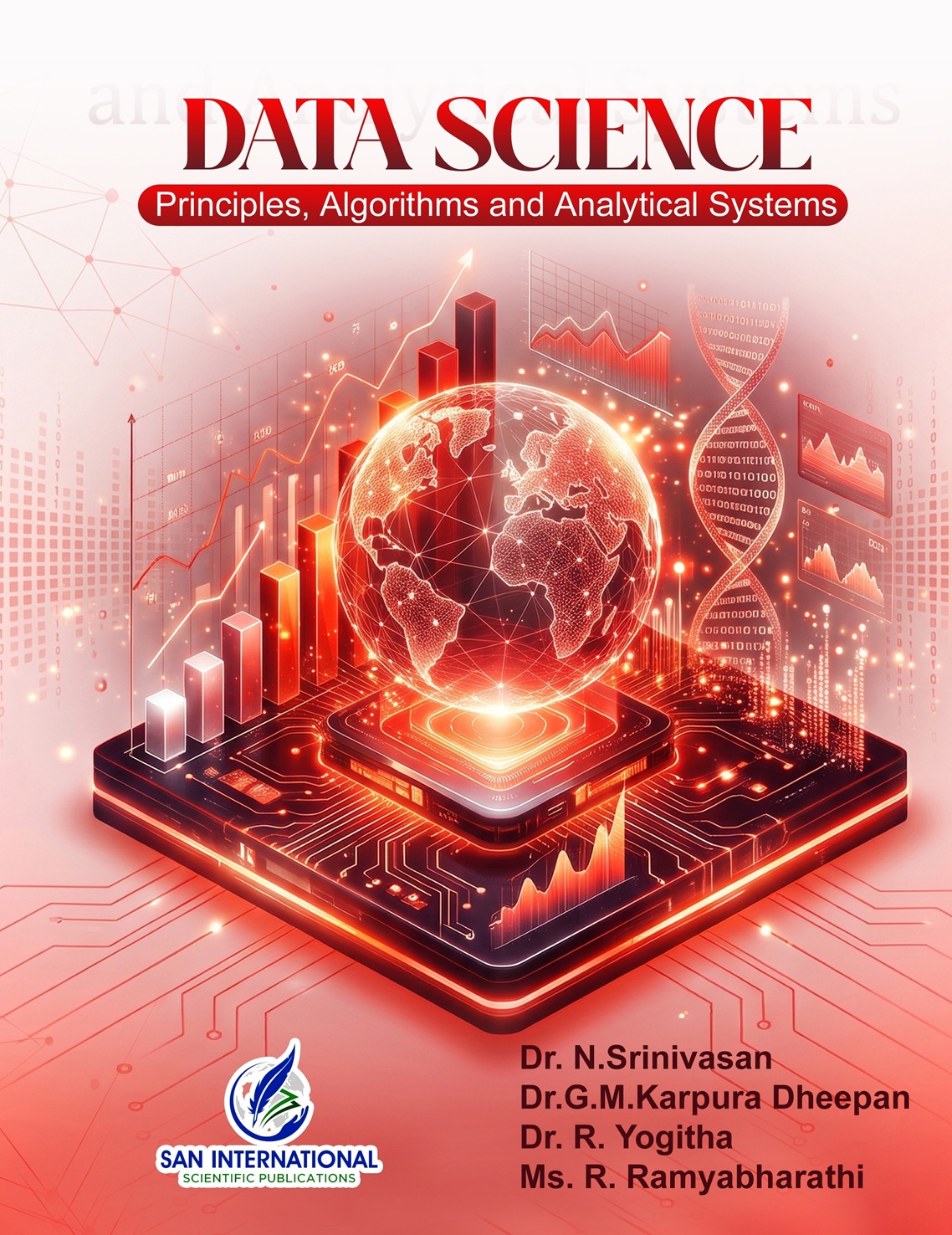
Authors: Dr. N. Srinivasan, Dr. G.M. Karpura Dheepan, Dr. R. Yogitha, and Ms. R. Ramyabharathi
ISBN: 978-81-17787-49-6
DOI: https://doi.org/10.59646/900
Date of Publication: November 25, 2026
Preface
The book Data Science: Principles, Algorithms, and Analytical Systems provides a comprehensive introduction to the fundamental principles, computational techniques, algorithms, and analytical methodologies that form the foundation of modern data science. In an era characterized by the rapid generation of large volumes of structured and unstructured data, the ability to collect, process, analyze, and interpret information has become essential for scientific research, technological innovation, and informed decision-making. Data science integrates statistical methods, mathematical principles, computer programming, machine learning, and analytical reasoning to transform raw data into meaningful knowledge and actionable insights. This book is designed to develop a strong understanding of the data science lifecycle, data acquisition and preprocessing, predictive modeling, pattern discovery, advanced machine learning, and analytical systems.
The book is organized into six units, progressing from fundamental concepts to advanced analytical applications. Unit I introduces the foundations of data science, covering its definition, scope, lifecycle, data types, data sources, data-driven decision-making, and the essential roles of statistics, computing, and analytical thinking. Unit II focuses on data acquisition and preprocessing, explaining data collection through databases and APIs, data cleaning, wrangling, missing-value treatment, outlier handling, normalization, feature engineering, data integration, visualization, and preprocessing pipelines. Unit III explores supervised learning algorithms, including linear and logistic regression, k-nearest neighbors, decision trees, ensemble methods, support vector machines, and Naïve Bayes classification, along with model evaluation and cross-validation techniques. Unit IV examines unsupervised learning and pattern discovery through clustering algorithms, density-based methods, principal component analysis, association rule mining, anomaly detection, and feature extraction approaches. Unit V presents advanced machine learning and deep learning methodologies, emphasizing neural network fundamentals, convolutional neural networks, recurrent neural networks, ensemble learning, transfer learning, time-series forecasting, and model optimization strategies. Unit VI extends the discussion towards predictive and prescriptive analytics, regression and classification for forecasting, decision support systems, recommender systems, simulation techniques, risk modeling, and business intelligence integration. Together, these units establish a systematic understanding of how different algorithms and analytical approaches can be applied to address complex real-world problems and support intelligent decision-making across diverse domains.
This book is intended for undergraduate and postgraduate students, research scholars, academicians, data science professionals, and readers interested in developing their knowledge of modern analytical systems. The concepts and methodologies are presented in a structured manner to strengthen both theoretical understanding and practical analytical skills. By connecting statistical foundations with computational intelligence and advanced analytical techniques, this book aims to provide readers with the knowledge required to understand, develop, evaluate, and apply data-driven solutions. It is hoped that Data Science: Principles, Algorithms, and Analytical Systems will serve as a valuable academic and professional resource, encouraging analytical thinking, computational problem-solving, and the effective utilization of data for research, innovation, and informed decision-making.