
Electrical Machines: Principles, Analysis, Design, and Applications of DC and AC Machines
Electrical Machines: Principles, Analysis, Design, and Applications of DC and AC Machines
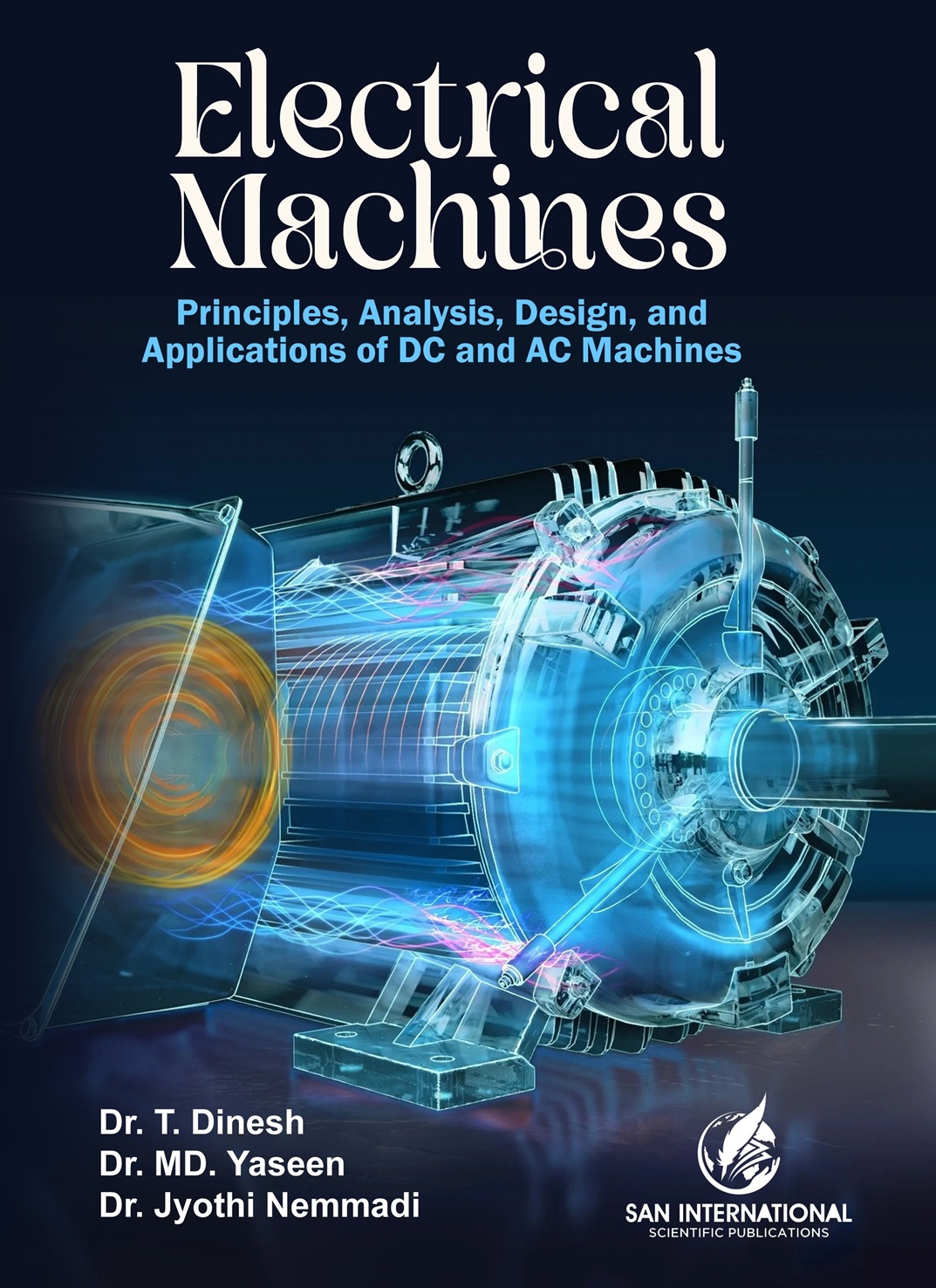
Authors: Dr. T. Dinesh, Dr. MD. Yaseen, and Dr. Jyothi Nemmadi
ISBN: 978-81-17787-41-0
DOI: https://doi.org/10.59646/892
Date of Publication: November 20, 2026
Preface
Electrical machines are fundamental components of modern electrical and industrial systems, enabling the conversion of electrical energy into mechanical energy and vice versa. The book Electrical Machines: Principles, Analysis, Design, and Applications of DC and AC Machines provides a comprehensive introduction to the principles, construction, operation, analysis, and performance characteristics of electrical machines. It presents the essential electromagnetic concepts, magnetic circuits, electromagnetic induction, energy conversion mechanisms, and constructional features that form the foundation for understanding DC and AC machines. The contents are systematically organized into five units, covering electromagnetic principles, DC generators, DC motors, transformers, and AC machines, with particular emphasis on alternators and synchronous motors.
The book explores the operating principles, mathematical relationships, equivalent circuits, performance characteristics, voltage regulation, speed control techniques, losses, efficiency, and testing methods associated with different electrical machines. It also discusses practical aspects such as armature reaction, starting methods, braking techniques, transformer connections, synchronization, and power factor control. Relevant analytical concepts and performance evaluation methods are incorporated to strengthen the understanding of electrical machine behaviour under different operating conditions. Designed for undergraduate students, engineering learners, and technical professionals, this book serves as a valuable learning resource for developing fundamental knowledge and practical understanding of electrical machines and their applications in power generation, transmission, industrial drives, and electrical engineering systems.