Carbon Materials from Waste Biomass: Synthesis, Characterization and Catalytic & Energy Applications
Carbon Materials from Waste Biomass: Synthesis, Characterization and Catalytic & Energy Applications
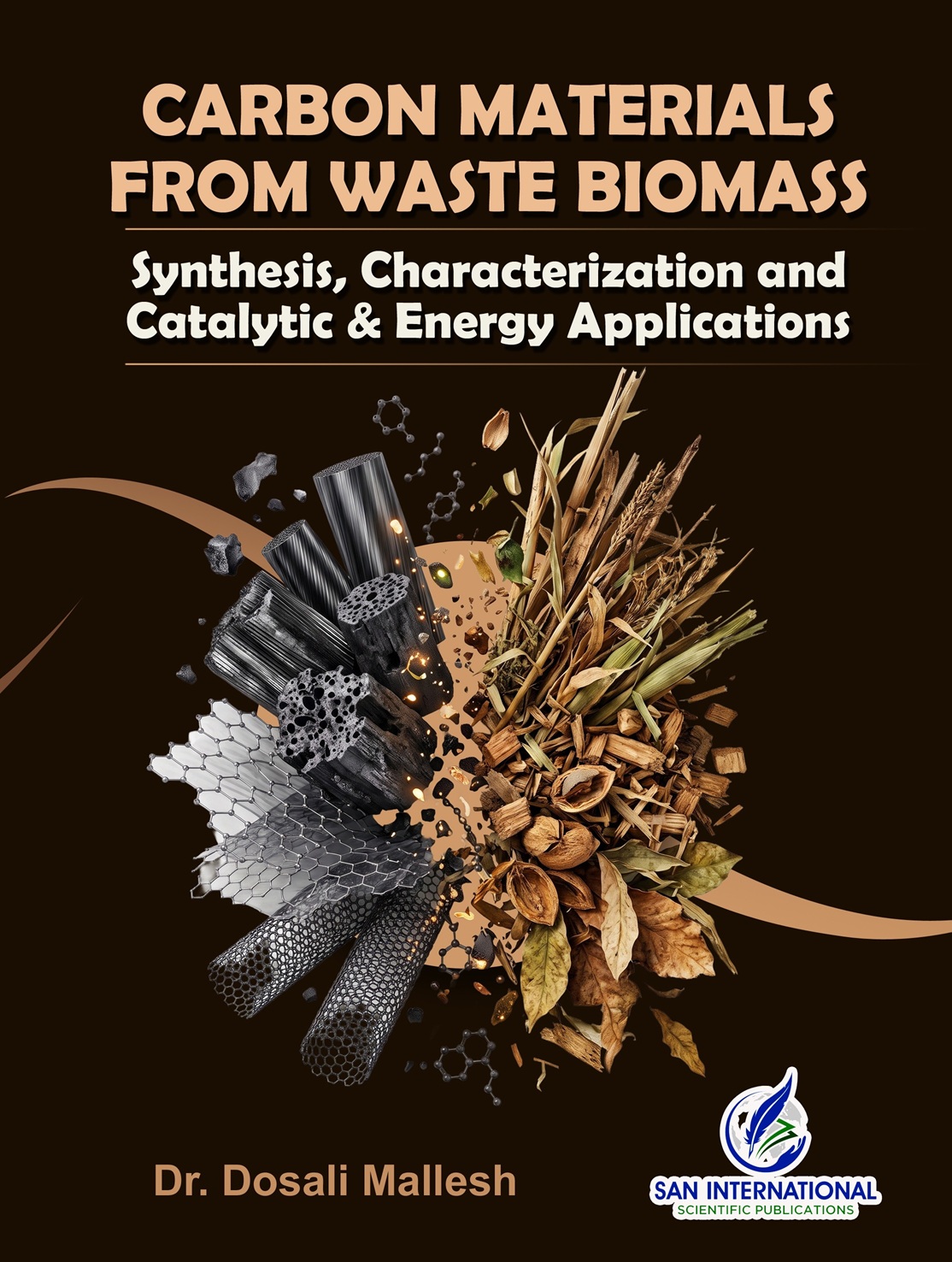
Author: Dr. Dosali Mallesh
ISBN: 978-81-17787-21-2
DOI: https://doi.org/10.59646/871
Date of Publication: October 30, 2026
Preface
The rapid advancement of materials science, environmental engineering, and energy technologies has increased the demand for sustainable, cost-effective, and high-performance carbon materials. Biomass waste, generated from agricultural activities, forestry operations, food processing, and various industrial processes, represents an abundant renewable resource for producing value-added carbon materials. Converting these waste resources into functional carbon materials provides an effective approach to waste valorization, resource recovery, and sustainable materials development while reducing dependence on conventional fossil-based carbon precursors. This book, Carbon Materials from Waste Biomass: Synthesis, Characterization and Catalytic & Energy Applications, presents a comprehensive overview of the fundamentals, synthesis strategies, structural characteristics, surface properties, and technological applications of biomass-derived carbon materials. It explores different carbon structures, including graphitic carbon, amorphous carbon, activated carbon, carbon nanotubes, and graphene-based materials, with particular emphasis on their physicochemical properties, surface functionalization, heteroatom doping, porosity, and catalytic activity. The book further examines the utilization of diverse biomass feedstocks, including agricultural residues, fruit and vegetable wastes, nutshells, and food-processing by-products, through conventional carbonization, pyrolysis, hydrothermal carbonization, chemical activation, microwave-assisted synthesis, and other advanced preparation techniques.
Detailed attention is given to analytical and characterization techniques such as X-ray diffraction, Raman spectroscopy, Fourier-transform infrared spectroscopy, X-ray photoelectron spectroscopy, electron microscopy, BET surface area analysis, and thermal characterization for understanding the structural, morphological, and chemical properties of the synthesized materials. The subsequent discussions focus on the applications of biomass-derived carbon as adsorbents and heterogeneous catalysts for removing heavy metals, dyes, pharmaceutical contaminants, pesticides, and other environmental pollutants, along with their roles in oxidation, reduction, carbon dioxide capture, and wastewater treatment. The book also highlights the growing importance of biomass-derived carbon in electrochemical energy technologies, particularly as anodic materials for lithium-ion, sodium-ion, and potassium-ion batteries, as well as electrode materials for supercapacitors, electrocatalytic systems, and fuel cells. By integrating fundamental concepts, synthesis methodologies, characterization approaches, and application-oriented developments, this book aims to provide valuable technical knowledge to undergraduate and postgraduate students, research scholars, academicians, materials scientists, chemical engineers, and professionals working in nanotechnology, catalysis, environmental remediation, and energy storage. It is expected that the knowledge presented in this book will encourage further research into sustainable carbon material development and promote the effective conversion of waste biomass into technologically valuable materials for environmental protection, catalytic processes, and next-generation energy applications.