
Machine Learning Techniques: Theory, Algorithms and Applications
Machine Learning Techniques: Theory, Algorithms and Applications
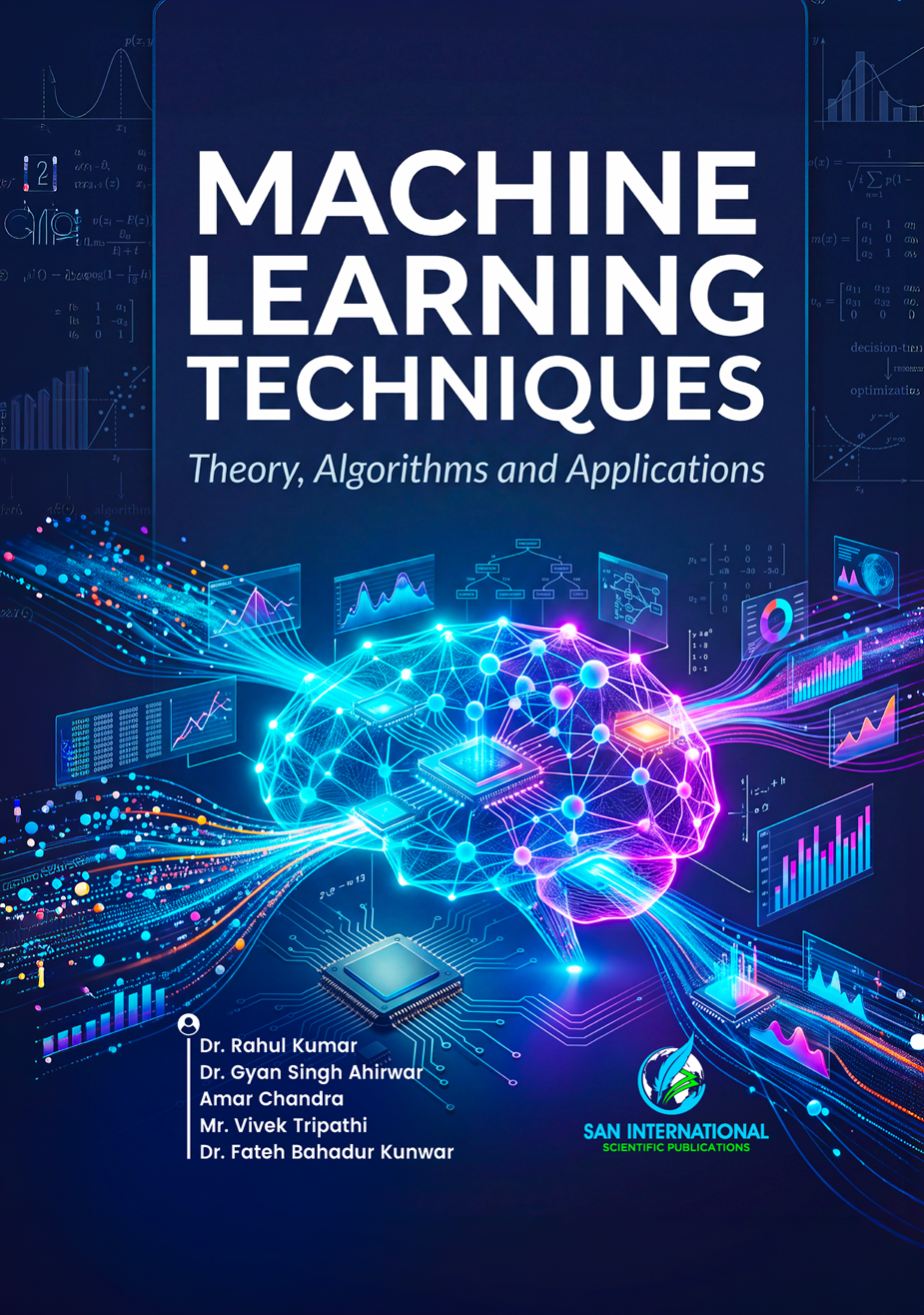
Authors: Dr. Rahul Kumar, Dr. Gyan Singh Ahirwar, Mr. Amar Chandra, Mr. Vivek Tripathi, and Dr. Fateh Bahadur Kunwar
ISBN: 978-81-69857-87-1
DOI: https://doi.org/10.59646/844
Date of Publication: October 16, 2026
Preface
Machine learning has emerged as a fundamental discipline for developing computational systems capable of learning patterns from data, improving performance through experience, and supporting intelligent decision-making across diverse domains. Machine Learning Techniques: Theory, Algorithms and Applications presents a structured and technically oriented treatment of the major concepts, mathematical foundations, learning algorithms, and practical applications that constitute modern machine learning. The book is designed to establish a strong progression from fundamental learning principles to advanced computational models, enabling readers to understand not only how machine learning algorithms operate but also the theoretical reasoning, mathematical formulation, optimization procedures, and practical considerations underlying their implementation. The coverage begins with the fundamental concepts of machine learning, including different learning paradigms, well-defined learning problems, learning-system design, historical development, major machine learning approaches, and challenges such as overfitting, underfitting, dimensionality, data quality, class imbalance, and distribution shift.
Unit 1 establishes the conceptual foundation by introducing supervised, unsupervised, semi-supervised, and reinforcement learning, followed by the formulation and design of learning systems and an overview of important machine learning approaches. Unit 2 develops the mathematical foundations of regression, covering simple and multiple linear regression, least-squares estimation, gradient descent, goodness-of-fit measures, logistic regression, log-loss, maximum likelihood, and decision boundaries. Unit 3 focuses on Bayesian learning, progressing from Bayes theorem, prior probability, maximum likelihood and MAP hypotheses to concept learning, Find-S, candidate elimination, Bayes optimal classification, Naïve Bayes, Bayesian belief networks, inference, and the Expectation-Maximization algorithm with Gaussian mixture model applications.
Unit 4 presents Support Vector Machines through their mathematical formulation, dual representation, kernel trick, Sequential Minimal Optimization, kernel types, separating hyperplanes, functional and geometric margins, margin maximization, slack variables, generalization properties, and practical limitations. Unit 5 examines decision tree learning, beginning with tree construction and progressing through entropy, information gain, inductive bias, hypothesis-space search, information theory, Kullback–Leibler divergence, information gain ratio, ID3, and issues associated with overfitting, continuous attributes, and missing values. Unit 6 introduces instance-based learning through k-Nearest Neighbour learning, locally weighted regression, radial basis function networks, and case-based learning, emphasizing mathematical formulation, similarity measures, kernel weighting, training strategies, adaptation, and theoretical limitations such as the curse of dimensionality.
Unit 7 develops artificial neural networks from perceptrons and their convergence properties to multilayer perceptrons, nonlinear activation functions, empirical risk minimization, backpropagation, gradient descent, the delta rule, multilayer architectures, generalization, regularization, dropout, early stopping, and Self-Organizing Maps. Unit 8 advances these concepts into deep learning, explaining the transition from conventional machine learning to deep architectures, artificial neurons, multilayer formulations, activation functions, optimization, convolutional neural networks, convolution operations, layer structures, pooling, fully connected layers, network training, and CNN-based case studies involving diabetic retinopathy and smart-speaker development.
Unit 9 introduces reinforcement learning as a framework for sequential decision-making, covering Markov Decision Processes, return, value functions, Bellman equations, Q-learning, algorithmic workflows, practical engineering formulation, and applications in robotics, industrial automation, autonomous vehicles, intelligent transportation, and financial optimization. The unit further introduces Deep Q Learning through experience replay and target networks. Unit 10 concludes the book with genetic algorithms and evolutionary learning, covering encoding, population initialization, fitness formulation, selection, genetic operators, reproduction cycles, replacement and elitism, convergence, crossover, mutation, genetic programming, evolutionary models, memetic algorithms, and applications including feature selection, hyperparameter tuning, combinatorial optimization, and neural architecture and weight optimization.
Overall, this book is intended to bridge machine learning theory, algorithmic formulation, mathematical reasoning, and application-oriented understanding. By presenting classical learning techniques alongside neural networks, deep learning, reinforcement learning, and evolutionary optimization, it provides a coherent foundation for students, researchers, educators, and practitioners seeking to develop a deeper understanding of machine learning systems. The systematic organization of concepts, algorithms, mathematical principles, and solved or application-oriented problems makes the book useful for academic study as well as for readers preparing to design, analyze, implement, and evaluate intelligent computational models in contemporary data-driven environments.