
Neuromorphic Computing: AI, Neural Hardware, and Intelligent Systems
Neuromorphic Computing: AI, Neural Hardware, and Intelligent Systems
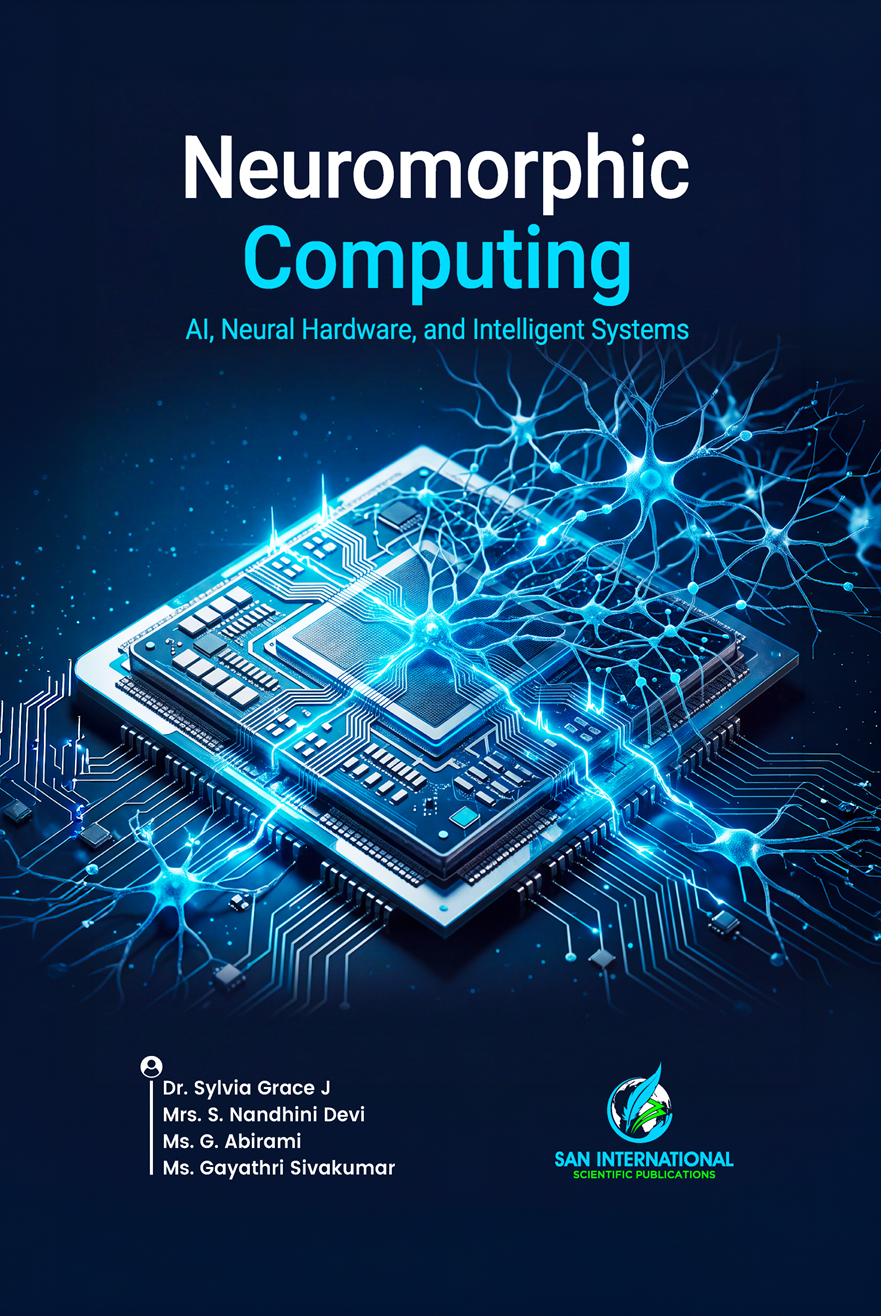
Authors: Dr. Sylvia Grace J, Mrs. S. Nandhini Devi, Ms. G. Abirami, and Ms. Gayathri Sivakumar
ISBN: 978-81-69857-82-6
DOI: https://doi.org/10.59646/838
Date of Publication: October 01, 2026
Preface
Neuromorphic computing represents a transformative paradigm in artificial intelligence that seeks to overcome the limitations of conventional computing by drawing inspiration from the structure, functionality, and efficiency of biological neural systems. By integrating brain-inspired computation, spiking neural networks, event-driven processing, specialized neural hardware, and intelligent sensing, neuromorphic systems provide new approaches for building AI technologies that operate with low latency, reduced energy consumption, and adaptive learning capabilities. Neuromorphic Computing: AI, Neural Hardware, and Intelligent Systems presents a comprehensive exploration of the theoretical foundations, computational models, hardware architectures, learning mechanisms, sensing technologies, and practical applications that define this rapidly developing field. The book begins with the fundamental principles of neuromorphic computation, biological inspiration, neural coding, spike-based representation, and the differences between conventional von Neumann architectures and brain-inspired computing models. It then examines spiking neural networks, integrate-and-fire models, spike-timing-dependent plasticity, temporal and rate coding, synaptic plasticity, and learning algorithms for developing efficient neural computation.
The subsequent units focus on neuromorphic hardware, including digital and analog circuits, memristive technologies, crossbar arrays, in-memory computing, hardware acceleration, and neuromorphic system-on-chip architectures. Particular attention is given to event-based vision, dynamic vision sensors, auditory and tactile interfaces, sensor–processor co-design, and ultra-low-power edge intelligence, highlighting the importance of integrating sensing and computation for real-time intelligent systems. The book further explores neuromorphic AI through deep learning, ANN-to-SNN conversion, hybrid ANN–SNN models, continual learning, few-shot learning, reinforcement learning, associative memory, and cognitive computing. Finally, it addresses system-level engineering and emerging applications in robotics, autonomous navigation, computer vision, speech intelligence, intelligent prosthetics, industrial edge systems, autonomous IoT, and energy-efficient AI acceleration. Designed for students, researchers, engineers, and professionals in artificial intelligence, computer science, electronics, robotics, and intelligent systems, this book provides a technical foundation for understanding how neural principles can be translated into computational architectures and intelligent hardware. It also establishes a conceptual bridge between neuroscience-inspired algorithms and practical AI systems, offering insights into the development of adaptive, event-driven, real-time, and energy-efficient intelligent machines.