
Global Perspectives and Emerging Dimensions of Multidisciplinary Research
Global Perspectives and Emerging Dimensions of Multidisciplinary Research
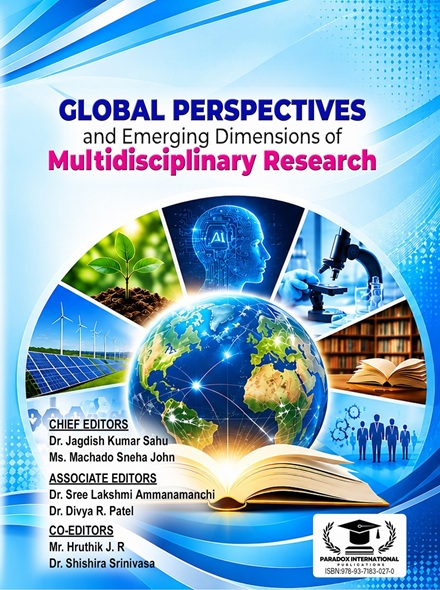
Chief Editors: Dr. Jagdish Kumar Sahu and Ms. Machado Sneha John
Associate Editors: Dr. Sree Lakshmi Ammanamanchi and Dr. Divya R. Patel
Co-Editors: Mr. Hruthik J. R and Dr. Shishira Srinivasa
ISBN: 978-93-7183-027-0
DOI: https://doi.org/10.59646/833
Date of Publication: September 29, 2026
Chapters and Authors
Chapter 2: AI-Driven Workforce Planning and Organizational Sustainability – Dr Amarjot Verma
Chapter 3: Gratitude Interventions and Academic Resilience Among University Students – Dr R Nandhini
Chapter 12: Strategic Human Resource Management and Organizational Development – Ms. Vanila V
Chapter 17: Apparatus for Drug Content Uniformity Analysis – Ms. Meena M
Preface
Global Perspectives and Emerging Dimensions of Multidisciplinary Research presents a diverse collection of scholarly contributions that reflects the expanding scope, complexity, and interconnectedness of contemporary research. In an era characterized by rapid technological advancement, environmental transformation, evolving social structures, and changing organizational practices, meaningful research increasingly requires perspectives that extend beyond traditional disciplinary boundaries. This edited volume brings together studies from management, business, psychology, education, social sciences, literature, environmental studies, engineering, pharmaceutical sciences, healthcare, and finance, thereby demonstrating the value of multidisciplinary approaches in addressing emerging academic and societal challenges.
The chapters included in this volume explore a broad spectrum of contemporary issues. The discussions on sustainable packaging, consumer retention, digital retail touchpoints, behavioral economics, and consumer decision-making highlight the changing relationship between businesses, consumers, technology, and sustainability. Contributions addressing AI-driven workforce planning, strategic human resource management, employee satisfaction, organizational performance, and evolving performance management systems examine how organizations are adapting their people-management practices to meet the demands of dynamic global environments. These studies provide valuable perspectives on organizational sustainability, workforce transformation, employee well-being, and performance-oriented management practices.
The volume also incorporates important social, cultural, psychological, and environmental dimensions of research. Studies on gratitude interventions and academic resilience, digital burnout and remote work culture, and the experiences of Irula tribal women in the Nilgiris explore contemporary human experiences from diverse perspectives. The examination of villages as cultural spaces through translation studies further demonstrates how literature and cultural interpretation can contribute to a deeper understanding of social identity, heritage, and regional experiences. Similarly, research concerning climate change and behavioral adaptations in wildlife emphasizes the significance of understanding ecological responses to environmental transformation.
Engineering, environmental policy, healthcare, pharmaceutical technology, and financial governance constitute other important dimensions represented in this collection. Research on the seismic performance of reinforced concrete frames addresses structural safety and engineering resilience, while the study of environmental policies examines their influence on industrial carbon footprints. The discussion of individualized antimicrobial therapy through PK/PD-guided approaches highlights the movement toward precision and evidence-based healthcare. The chapter on drug content uniformity analysis reflects the importance of pharmaceutical quality assessment and technological innovation. The examination of financial resilience and governance challenges of limited liability partnerships adds an important financial and regulatory perspective, particularly within an urban business context.
Collectively, these contributions demonstrate that contemporary research is increasingly shaped by the interaction of technology, sustainability, human behavior, organizational transformation, healthcare innovation, environmental responsibility, cultural understanding, and economic resilience. Rather than viewing these areas as isolated domains, this volume emphasizes their interdependence and the opportunities that emerge when knowledge is shared across disciplines. The chapters provide researchers, academicians, practitioners, students, policymakers, and other readers with varied perspectives that can stimulate further inquiry, interdisciplinary collaboration, and application-oriented research.
This book is therefore intended not merely as a compilation of individual studies, but as a representation of the emerging intellectual landscape in which multidisciplinary thinking has become essential. The diverse themes and approaches presented by the contributors illustrate how research can respond to complex real-world problems through multiple perspectives and methodological frameworks. It is hoped that Global Perspectives and Emerging Dimensions of Multidisciplinary Research will serve as a valuable academic resource and encourage continued exploration, collaboration, innovation, and knowledge creation across disciplinary boundaries.