Indian Knowledge Systems: Ancient Wisdom for the Intelligent Age
Indian Knowledge Systems: Ancient Wisdom for the Intelligent Age
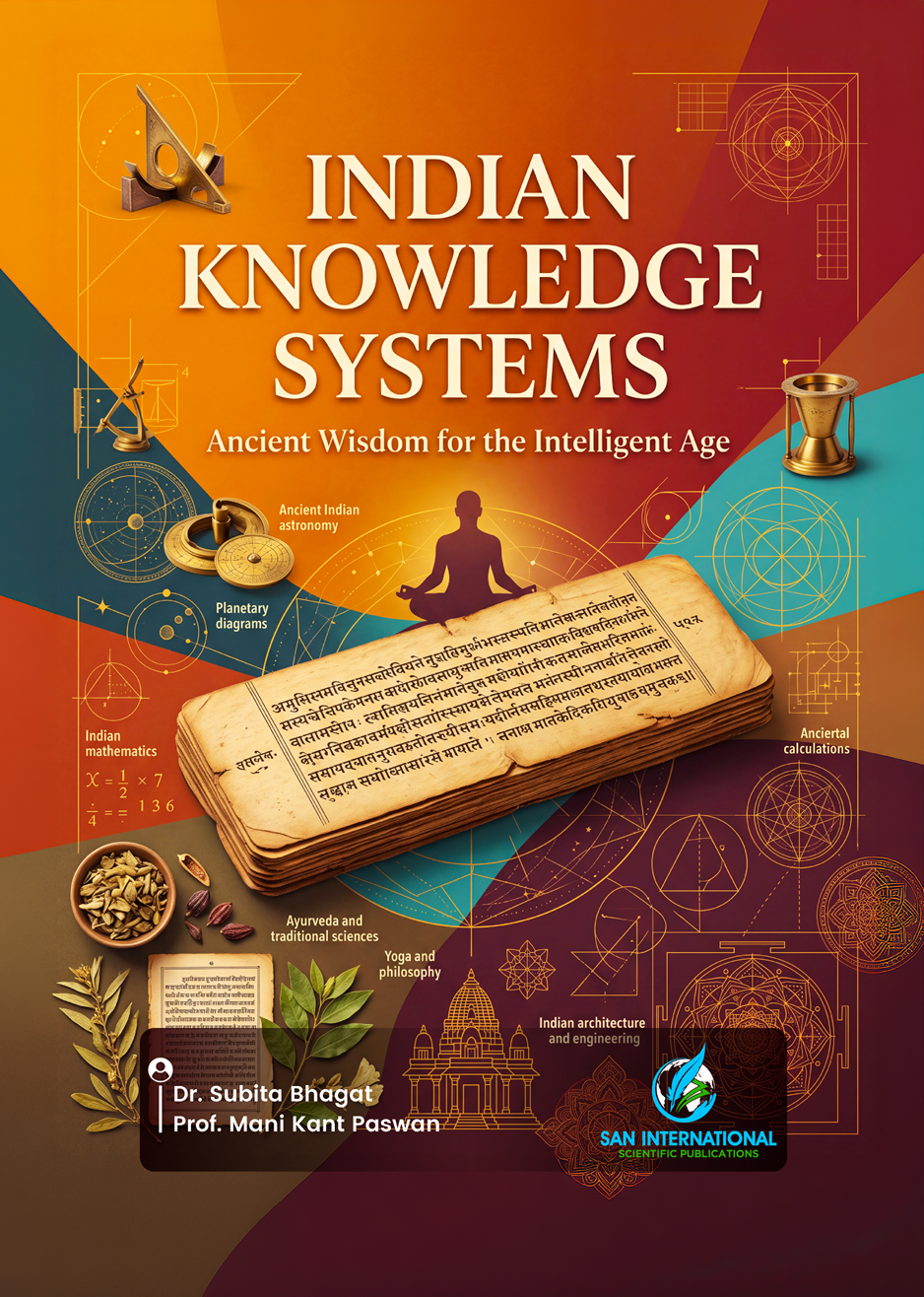
Authors: Dr. Subita Bhagat, and Prof. Mani Kant Paswan
ISBN: 978-81-69857-77-2
DOI: https://doi.org/10.59646/834
Date of Publication: September 28, 2026
Preface
Indian Knowledge Systems: Ancient Wisdom for the Intelligent Age presents a comprehensive exploration of India’s diverse intellectual, scientific, philosophical, artistic, linguistic, medical, and technological traditions, while examining their continuing relevance in the contemporary era. Indian Knowledge Systems (IKS) represent a vast and interconnected heritage of inquiry developed over centuries through observation, reasoning, experimentation, dialogue, practice, and transmission across generations. Far from being confined to historical or cultural studies, these traditions provide valuable frameworks for understanding knowledge, human cognition, society, health, mathematics, language, architecture, ecology, and the relationship between individuals and the wider world.
The book begins by establishing the foundations and knowledge architecture of Indian Knowledge Systems, with particular attention to concepts such as pramāṇa, valid cognition, prāmāṇyavāda, śruti, smṛti, itihāsa, purāṇa, and the guru–śiṣya paramparā. These foundations demonstrate that Indian intellectual traditions developed sophisticated approaches to the generation, validation, preservation, interpretation, and transmission of knowledge. The discussion then moves into Indian philosophy, logic, and cognitive traditions, introducing the six classical darśanas, Buddhist and Jain philosophical perspectives, Nyāya logic, theories of inference and perception, and the rich culture of structured debate. These traditions reveal a sustained concern with rational inquiry, epistemic justification, argumentation, cognition, and the disciplined examination of competing viewpoints.
The third unit examines mathematics, astronomy, and scientific knowledge traditions, highlighting the development of numerical thought, the decimal place-value system, zero, geometric techniques associated with the Śulba Sūtras, arithmetic and algebraic methods, and the contributions of scholars such as Āryabhaṭa, Brahmagupta, Bhāskara I, Bhāskarācārya, and the Kerala school. Indian astronomical and calendrical traditions are also explored through planetary models, trigonometry, computational procedures, astronomical instruments, and the mathematical foundations of the pañcāṅga. The objective is not merely to celebrate historical achievements but to understand the intellectual methods, mathematical reasoning, observational practices, and computational approaches through which these achievements emerged.
The fourth unit turns to Ayurveda, Yoga, and traditional health knowledge, presenting classical concepts including pañcamahābhūta, tridoṣa, dhātu, mala, agni, āma, prakṛti, vikṛti, rasāyana, and vyādhikṣamatva. It further explores diet, lifestyle, seasonal adaptation, behavioural principles, Haṭha Yoga, āsana, prāṇāyāma, pratyāhāra, dhāraṇā, dhyāna, and the Siddha medical tradition. These subjects are approached as historical and intellectual knowledge traditions, while encouraging critical engagement with their concepts and their potential intersections with contemporary research rather than assuming equivalence with modern biomedical frameworks.
The fifth and final unit expands the discussion to language, literature, arts, architecture, knowledge representation, and digital transformation. It examines Sanskrit, Classical Tamil, Pāli, Prakrit, and other linguistic traditions; the formal architecture of Pāṇinian grammar; Vāstu Śāstra; urban and temple planning; performing arts; the Nāṭyaśāstra; music, dance, painting, and architectural heritage. Importantly, the book also looks forward by addressing manuscript digitization, optical character recognition, handwritten-text recognition, natural language processing, computer vision, semantic technologies, knowledge graphs, digital humanities, and AI-enabled preservation and interpretation. This creates a bridge between traditional knowledge resources and emerging computational technologies.
A central theme throughout the book is that the future of IKS should not be limited to archival preservation or nostalgic revival. Instead, the knowledge traditions can become subjects of rigorous interdisciplinary study, critical interpretation, digitization, validation, and responsible application. Concepts originating in philosophy, mathematics, medicine, ecology, linguistics, architecture, and the arts may provide useful questions, perspectives, models, or historical insights for contemporary scholarship when examined through appropriate scientific and humanistic methodologies. Such engagement requires both intellectual openness and methodological caution: traditional claims should be understood in their historical contexts, evaluated according to the standards appropriate to the discipline, and distinguished carefully from modern scientific findings.
The title Indian Knowledge Systems: Ancient Wisdom for the Intelligent Age therefore reflects a dialogue between heritage and innovation. The “intelligent age” is characterized by artificial intelligence, computational knowledge systems, digital humanities, advanced analytics, interdisciplinary research, and increasingly complex societal challenges. In such an environment, understanding how earlier civilizations conceptualized knowledge, reasoning, language, health, mathematics, environment, aesthetics, and ethical responsibility can broaden contemporary perspectives. The integration of IKS with modern technologies should consequently be viewed not as a replacement for established scientific methods, but as an opportunity for new forms of interdisciplinary inquiry.
This book is intended for students, researchers, educators, scholars, professionals, and readers interested in India’s intellectual heritage and its contemporary possibilities. By bringing together foundational concepts, philosophical reasoning, mathematical and scientific traditions, health and wellness knowledge, linguistic and artistic systems, and emerging digital applications, the book seeks to encourage informed curiosity and critical scholarship. Ultimately, it invites readers to approach Indian Knowledge Systems not simply as remnants of the past, but as a rich intellectual landscape whose ideas, methods, questions, and practices can continue to inspire meaningful inquiry in the present and future.