Artificial Intelligence and Machine Learning: Foundations, Algorithms, and Applications
Artificial Intelligence and Machine Learning: Foundations, Algorithms, and Applications
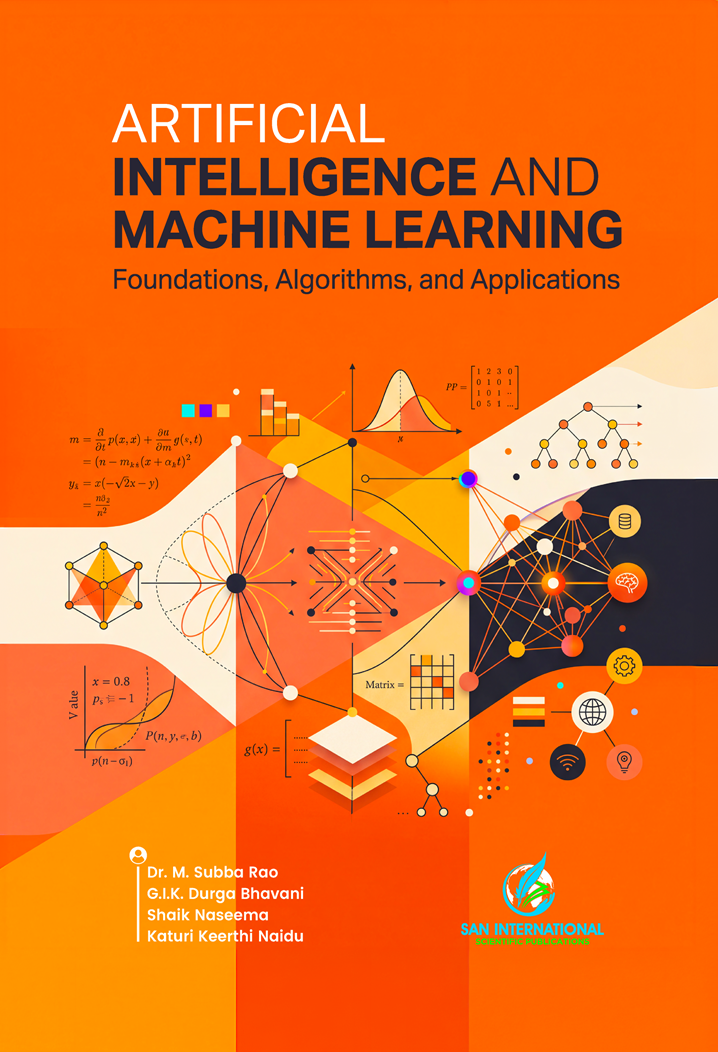
Authors: Dr. M. Subba Rao, G.I.K. Durga Bhavani, Shaik Naseema, and Katuri Keerthi Naidu
ISBN: 978-81-69857-69-7
DOI: https://doi.org/10.59646/821
Date of Publication: September 21, 2026
Preface
Artificial Intelligence (AI) and Machine Learning (ML) have emerged as transformative technologies that are reshaping computing, scientific research, industry, business, healthcare, engineering, and numerous other domains. From intelligent search and automated decision-making to deep learning, natural language processing, and autonomous systems, AI has evolved from a theoretical field of computer science into a powerful technological foundation for modern intelligent applications. Artificial Intelligence and Machine Learning: Foundations, Algorithms, and Applications is designed to provide a systematic and technically oriented introduction to the fundamental principles, mathematical foundations, algorithms, and practical applications of AI and ML.
The book begins with the foundations of Artificial Intelligence, introducing the definition, scope, historical evolution, and major concepts of intelligent systems. Intelligent agents, rationality, problem-solving, state-space representation, and search strategies are discussed as fundamental mechanisms for developing systems capable of reasoning and decision-making. Particular attention is given to heuristic search techniques, including A* and greedy search, which establish an important foundation for understanding computational problem solving and intelligent navigation.
The second unit develops the mathematical foundations required for Machine Learning, covering essential concepts from linear algebra, probability, statistics, optimization, and model evaluation. Vectors, matrices, eigenvalues, random variables, conditional probability, Bayes’ theorem, statistical measures, convex functions, and loss functions provide the mathematical framework necessary for understanding learning algorithms. The discussion of accuracy, precision, recall, F1-score, and the bias–variance trade-off further establishes the principles required for evaluating and improving predictive models.
The book then progresses to supervised learning algorithms, presenting major approaches for learning from labelled data. Linear and logistic regression, k-Nearest Neighbors, decision trees, Support Vector Machines, Random Forest, and boosting methods are examined from an algorithmic perspective. This is followed by unsupervised learning and clustering, where k-Means, hierarchical clustering, DBSCAN, Principal Component Analysis, dimensionality reduction, and association rule mining are introduced for discovering hidden structures and patterns in unlabeled datasets.
The fifth unit focuses on Deep Learning and Neural Networks, progressing from the biological inspiration of neural computation to perceptrons, multilayer perceptrons, activation functions, and backpropagation. Modern architectures such as Convolutional Neural Networks, Recurrent Neural Networks, Long Short-Term Memory networks, and Transformers are introduced to demonstrate how deep learning has expanded the capabilities of AI in image, sequential, and language-based applications. The sixth unit extends intelligent learning into Reinforcement Learning and Intelligent Decision Systems, covering Markov Decision Processes, Q-learning, value iteration, policy-gradient methods, deep reinforcement learning, and multi-agent systems.
Finally, the book explores Natural Language Processing and AI Applications, introducing text preprocessing, tokenization, word embeddings, language models, Transformers, sentiment analysis, chatbots, conversational AI, and speech recognition. These topics demonstrate the practical transition from fundamental algorithms to intelligent systems capable of processing, understanding, and generating human language.
Overall, this book is intended to serve as a comprehensive foundation for students, educators, researchers, and technology professionals seeking to understand the core concepts and algorithmic principles of Artificial Intelligence and Machine Learning. By combining foundational theory, mathematical concepts, classical algorithms, and contemporary AI architectures, the book provides a structured pathway from fundamental concepts to modern intelligent applications.