
Deep Time Intelligence: Artificial Intelligence Across the Palaeosciences
Deep Time Intelligence: Artificial Intelligence Across the Palaeosciences
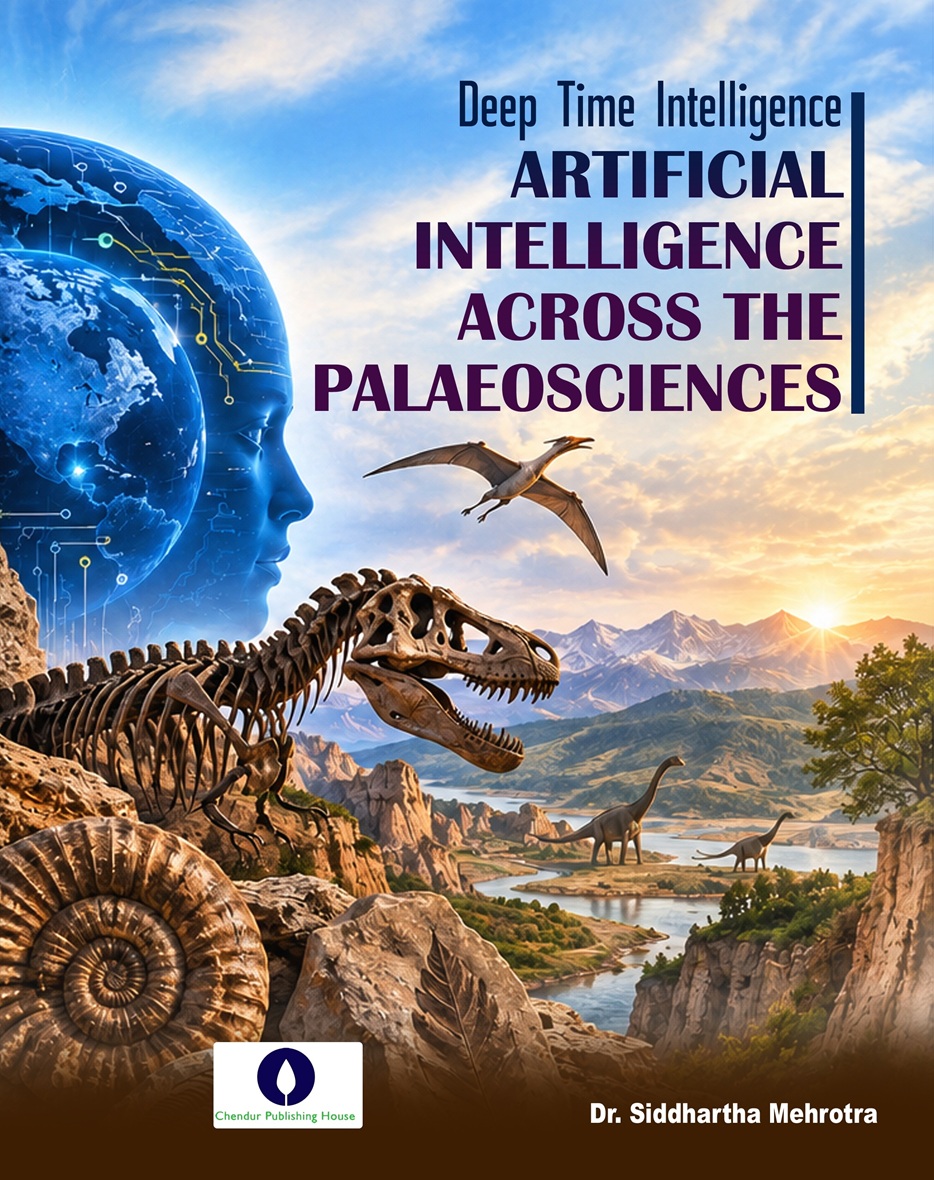
Author: Dr. Siddhartha Mehrotra
ISBN: 978-81-69388-29-0
DOI: https://doi.org/10.64971/cph.books.pub.17
Date of Publication: September 15, 2026
Preface
The history of Earth is recorded across an immense temporal canvas extending from the earliest stages of planetary evolution to the relatively recent past. Fossils, rocks, sediments, minerals, isotopes, magnetic signatures, climatic archives, landscapes, and geochemical records preserve fragments of this history, allowing palaeoscientists to reconstruct organisms, environments, ecosystems, climates, geological processes, and major transitions through deep time. Yet these archives are inherently incomplete, heterogeneous, spatially and temporally complex, and often affected by preservation biases, sampling limitations, chronological uncertainty, and measurement error. The rapidly expanding capabilities of Artificial Intelligence (AI) offer new opportunities to address these challenges and transform how deep-time evidence is discovered, processed, integrated, interpreted, and reconstructed. Deep Time Intelligence: Artificial Intelligence Across the Palaeosciences explores this emerging convergence of AI and palaeoscience. The central premise of this book is that AI should not be viewed merely as a collection of computational tools, but as an enabling scientific framework capable of connecting diverse forms of evidence across disciplines and geological timescales.
The opening unit establishes the foundations of AI for palaeosciences and deep-time data. It introduces the scope and evolution of AI, the interdisciplinary architecture of the palaeosciences, geological time and temporal data representation, and the diverse fossil, geological, geochemical, geophysical, climatic, and environmental archives from which deep-time knowledge is derived. Particular attention is given to digitization, multimodal data, uncertainty, sampling and taphonomic biases, scientific literature mining, databases, ontologies, knowledge graphs, and interoperable data systems. These foundations provide the conceptual and computational basis for the applications developed throughout the subsequent units.
The second unit focuses on palaeontology and related disciplines, including micropalaeontology, palaeobotany, palynology, and ichnology. AI-enabled computer vision can support fossil discovery, segmentation, recognition, taxonomic identification, morphometric analysis, and three-dimensional reconstruction. Machine learning can also assist in the identification of microfossils, pollen and spores, ichnofabrics, and taphonomic patterns, while automated digital cataloguing can improve the management and accessibility of large palaeontological collections.
The third unit extends AI into palaeoecology, palaeobiogeography, evolution, and extinction studies. Reconstructing ancient ecosystems requires the integration of biological, environmental, geographical, and temporal evidence. AI can contribute to ecological niche modelling, species-distribution reconstruction, food-web analysis, biodiversity estimation, evolutionary-trait analysis, diversification modelling, adaptive-radiation studies, and the detection of extinction and recovery dynamics. Integrating fossil evidence with molecular and environmental information further creates opportunities to investigate evolutionary transitions and responses to changing Earth systems.
The fourth unit addresses palaeoclimatology, palaeoceanography, and ancient Earth-system reconstruction. Climate archives such as tree rings, ice cores, marine and terrestrial sediments, corals, speleothems, biomarkers, and stable-isotope records contain valuable evidence of past environmental conditions. AI methods can assist in proxy interpretation and the reconstruction of temperature, precipitation, aridity, atmospheric composition, ocean conditions, circulation, productivity, and abrupt climatic transitions. The integration of AI with Earth-system models provides additional opportunities for calibration, parameter optimization, and investigation of long-term climate–biodiversity interactions.
The fifth unit examines AI applications across stratigraphy, sedimentology, geochronology, geochemistry, and palaeogeography. Machine learning can support stratigraphic correlation, lithofacies classification, sequence-stratigraphic interpretation, sedimentary-basin analysis, petrographic image interpretation, depositional-environment reconstruction, geochemical data mining, provenance analysis, mineral and rock classification, age–depth modelling, geological dating, and palaeogeographic reconstruction.
The sixth unit expands the discussion to Palaeomagnetism, Palaeoseismology, Palaeovolcanology, Palaeoenvironmental hazards, and planetary palaeoscience. AI-assisted analysis of magnetic data can contribute to the reconstruction of ancient geomagnetic fields and polarity histories, while machine learning can help identify patterns associated with earthquakes, tsunamis, volcanic deposits, mass wasting, flooding, drought, wildfire, and other ancient hazards. Extending these approaches beyond Earth opens an additional frontier: the reconstruction and interpretation of ancient environments on other planetary bodies and the search for evidence of geological and potentially habitable conditions through planetary deep time.
The final unit considers the future of deep-time intelligence through multimodal foundation models, generative AI, vision-language models, digital twins, autonomous field systems, virtual palaeontological laboratories, and immersive deep-time environments. These emerging technologies could enable researchers to combine fossils, geological sections, maps, geochemical measurements, imagery, textual literature, spatial datasets, and simulation outputs within unified analytical frameworks.
This book is therefore designed to serve students, researchers, educators, geologists, palaeontologists, environmental scientists, Earth-system scientists, data scientists, and professionals interested in the emerging intersection of AI and deep-time research. It aims to provide both a conceptual foundation and a broad application-oriented perspective, demonstrating how computational intelligence can complement established palaeoscientific methods. Above all, Deep Time Intelligence seeks to encourage a new way of thinking about Earth’s past—one in which the immense, fragmented, and multidimensional evidence of deep time can be connected through intelligent computational methods while remaining firmly grounded in geological reasoning and scientific evidence. The future of palaeoscience may not simply be about looking further into the past, but about developing better intelligence with which to understand it.