
Known Issues: A Psychology Textbook for People Who Don’t Trust Textbooks
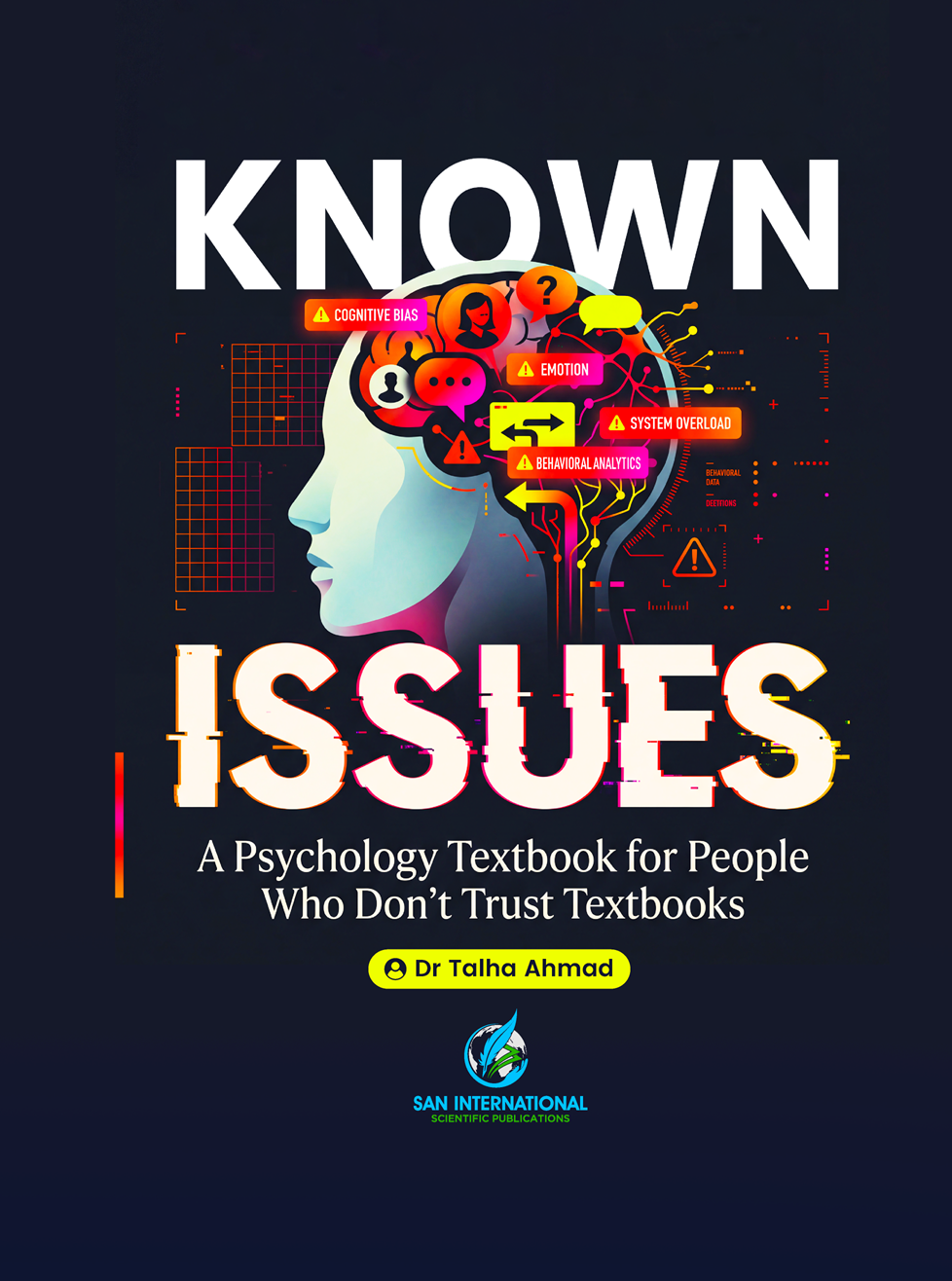
Known Issues: A Psychology Textbook for People Who Don’t Trust Textbooks
Author: Dr Talha Ahmad
ISBN: 978-81-69857-47-5
DOI: https://doi.org/10.59646/794
Date of Publication: August 15, 2026
Cite this book: Talha Ahmad (2026), Known Issues: A Psychology Textbook for People Who Don’t Trust Textbooks, San International Scientific Publications, ISBN: 978-81-69857-47-5, DOI: https://doi.org/10.59646/794
Preface
I did not set out to write a textbook. I set out to survive one, several times over, first as a student memorizing definitions I did not understand and later as a researcher trying to explain the same definitions to people who trusted me even less than I trusted the definitions myself. Somewhere in that gap, this book happened.
Aligarh was my fourth school, and though this is not the place to walk through the three that came before it, I will say that moving through different classrooms, teachers, and expectations left a mark on how I think about learning itself, and that mark runs through every chapter that follows. Before anything else, I want to acknowledge the Almighty, without whom none of this would have been possible, not the doctorate, not this book, and honestly not most mornings.
My late father and my mother gave me my first real education long before any university did. Both of them practiced medicine, and I grew up watching two people take other people’s suffering seriously for a living. I did not become a doctor of medicine, but I think I inherited the instinct anyway, just aimed at a different kind of pain. My father is no longer here to see this book finished, and I carry that quietly. My mother still is, and I hope this book makes her proud in the particular way that only a parent who has read very few psychology textbooks can be proud of one.
I am the youngest in my family, which in most households means you are simultaneously the most protected and the most humored. My elder siblings fall into the second category more than the first. They supported ideas of mine that, in hindsight, did not always deserve support, and hobbies that were, charitably, phases. We do not all live under one roof anymore, and some days we barely manage a phone call, but distance has not moved any of you out of where it counts. You are still in my heart, every one of you, whether or not I say it often enough.
My wife and my two children are, without exaggeration, the actual strength behind whatever this pen managed to produce. They put up with all nighters that had no clear end point, deadlines that ate into weekends that were supposed to be theirs, and a version of me that was present in the house but somewhere else entirely in the head. I am aware that a preface is a strange place to apologize and thank someone in the same sentence, but here we are. Thank you, and I am sorry, and thank you again.
I also want to name, without naming, two people from school who shaped more of this than they probably know. My primary school teacher, whom I am still in touch with today, and whom I remember with genuine fondness, taught me things that had nothing to do with the syllabus and everything to do with how to be curious without being arrogant about it. My vice principal in senior school put up with, honestly, all of it.
The questions I should not have asked in the tone I should not have asked them in, the ideas that were more enthusiasm than sense, and probably several things I am still unaware I did. If either of you ever reads this, know that it stuck.
Friends deserve their own paragraph, and this is a messy one because friendship rarely sorts itself into neat categories. One friend my own age still listens to me think out loud every now and then, which at this point is less a favor and more an act of endurance. The rest of my friends have gone well above that, in ways too specific and too personal to list here without turning this preface into something else entirely. You know who you are, and you know what you did.
Then there is a category that I suspect very few psychology prefaces have ever included: my online gaming friends. Most of them are Gen Z, considerably younger than me, a few closer to my own age, and I have never met a single one of them in person. We have spent hours together in worlds that do not exist, talking about things that very much do, including, more than once, this book. If you are reading this, know that I thank you too, and yes, I mean you specifically, not just the category.
This book is not the final word on psychology, nor is it trying to be. It is one fresh PhD’s attempt to write the book he wished someone had handed him earlier, built with the help, patience, and occasional forgiveness of everyone named and unnamed above. Whatever is useful in these pages belongs partly to all of them. Whatever is wrong is entirely mine.