
Ecological Genetics: Linking Genetic Variation with Environmental Change
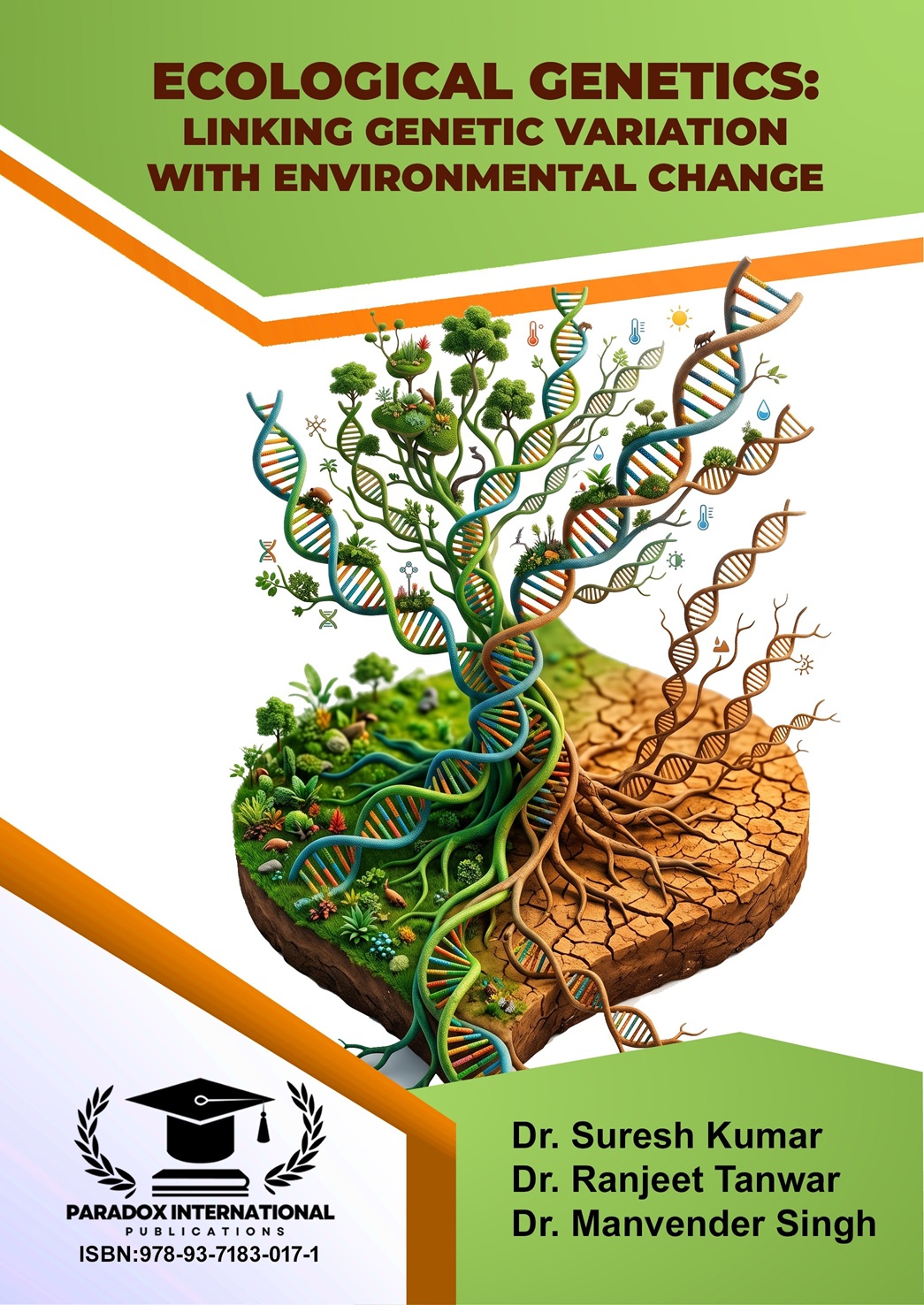
Ecological Genetics: Linking Genetic Variation with Environmental Change
Authors: Dr. Suresh Kumar, Dr. Ranjeet Tanwar, and Dr. Manvender Singh
ISBN: 978-93-7183-017-1
DOI: https://doi.org/10.59646/775
Date of Publication: July 20, 2026
Cite this book: Suresh K, Ranjeet T, and Manvender S, (2026), Ecological Genetics: Linking Genetic Variation with Environmental Change, Paradox International Publications & San International Scientific Publications, ISBN: 978-93-7183-017-1, DOI: https://doi.org/10.59646/775
Preface
The growing challenges of climate change, habitat degradation, biodiversity loss, pollution, and emerging environmental pressures have transformed the study of genetics from a laboratory-centered discipline into an essential field for understanding ecological sustainability. The textbook Ecological Genetics: Linking Genetic Variation with Environmental Change has been developed to provide students, researchers, educators, and professionals with a comprehensive understanding of how genetic diversity influences the survival, adaptation, and evolution of organisms in changing environments.
Ecological genetics bridges the disciplines of genetics, ecology, evolution, conservation biology, and environmental science. It explores the interactions between genes and the environment, demonstrating how genetic variation shapes ecological processes and how environmental changes influence genetic diversity within and among populations. The study of ecological genetics has become increasingly significant in addressing contemporary global issues such as species conservation, ecosystem resilience, biological invasions, agricultural sustainability, and the adaptive responses of organisms to climate change.
This textbook presents both classical principles and recent advances in ecological genetics. It begins with the fundamental concepts of population genetics, molecular genetics, and evolutionary biology before progressing to topics such as natural selection, adaptation, gene flow, genetic drift, mutation, landscape genetics, ecological genomics, conservation genetics, and evolutionary ecology. Special emphasis is placed on modern molecular techniques, including DNA sequencing, molecular markers, genome-wide association studies, environmental DNA (eDNA), bioinformatics, and genomic technologies that have revolutionized ecological research.
Recognizing the interdisciplinary nature of ecological genetics, the book integrates theoretical concepts with practical applications. Numerous examples drawn from plants, animals, microorganisms, and human-impacted ecosystems illustrate how genetic variation contributes to species survival and ecosystem stability. Case studies from terrestrial, aquatic, and agricultural ecosystems help readers appreciate the practical significance of ecological genetics in wildlife conservation, restoration ecology, disease management, sustainable agriculture, and biodiversity monitoring.
The chapters have been carefully organized in a logical sequence, enabling readers to build foundational knowledge before exploring advanced concepts. Each chapter includes clearly stated learning objectives, detailed explanations, illustrative diagrams, real-world examples, chapter summaries, review questions, and suggested readings to reinforce learning and encourage critical thinking. Particular attention has been given to the emerging role of genomic technologies and computational biology in ecological research. The integration of next-generation sequencing, remote sensing, artificial intelligence, geographic information systems (GIS), and ecological modeling has significantly expanded our ability to investigate evolutionary processes and monitor biodiversity under rapidly changing environmental conditions. These developments are presented in an accessible manner, making the textbook relevant for both introductory and advanced learners.
This book is intended to serve as a valuable resource for undergraduate and postgraduate students in genetics, zoology, botany, environmental science, biotechnology, microbiology, forestry, wildlife biology, agriculture, and life sciences. It is equally useful for researchers, conservation practitioners, policy makers, and professionals involved in biodiversity conservation, ecological restoration, and sustainable resource management.
The preparation of this textbook has drawn upon contemporary scientific literature and the collective contributions of researchers across multiple disciplines. Every effort has been made to ensure that the content is scientifically accurate, current, comprehensive, and pedagogically effective. While ecological genetics is a rapidly evolving field, this volume aims to provide a strong conceptual foundation that will inspire readers to explore new discoveries and contribute to future research.
It is our sincere hope that Ecological Genetics: Linking Genetic Variation with Environmental Change will foster a deeper appreciation of the intricate relationships between genes, organisms, and ecosystems. By understanding these connections, readers will be better equipped to address the environmental challenges of the twenty-first century and contribute to the conservation and sustainable management of Earth’s biological diversity.
We gratefully acknowledge the contributions of scientists, educators, reviewers, and students whose work has advanced the field of ecological genetics and inspired the development of this textbook. We also welcome constructive suggestions from readers that may help improve future editions.