
Fundamentals of Ecology (Printed in 170 GSM art paper)
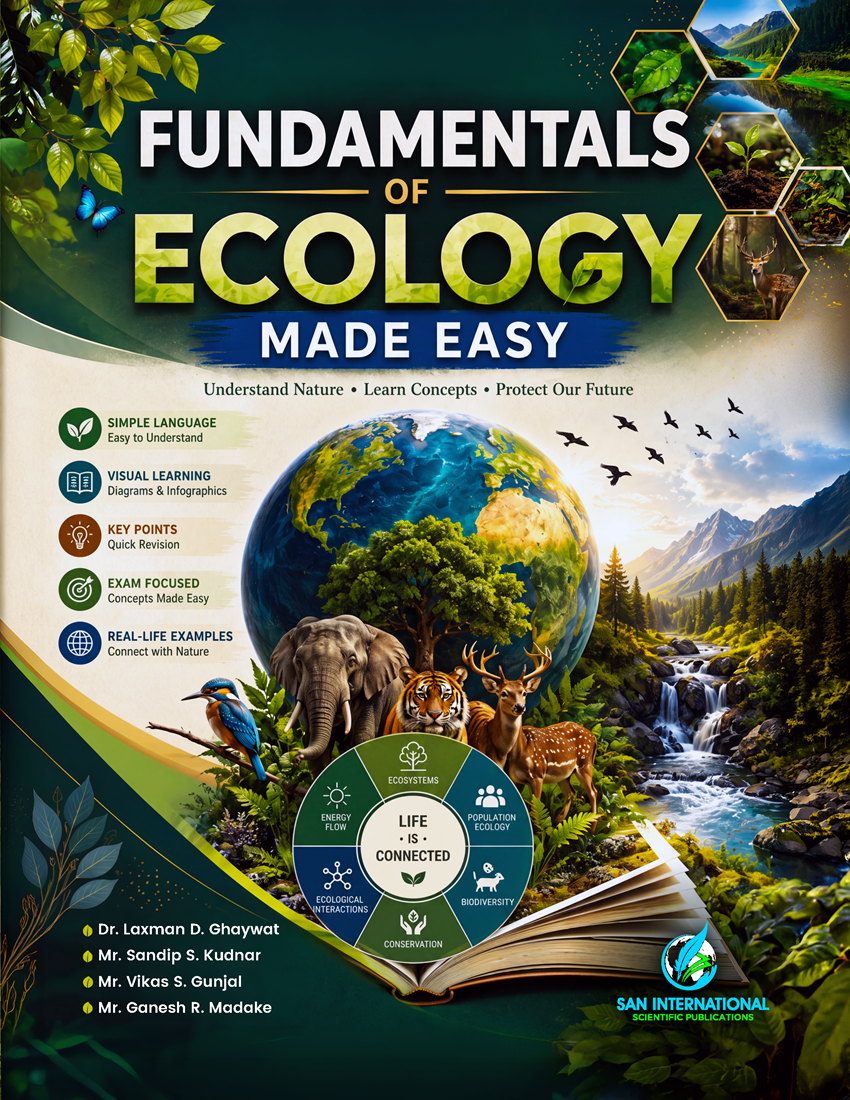
Fundamentals of Ecology (Printed in 170 GSM art paper)
Authors: Dr. Laxman D. Ghaywat, Mr. Sandip S. Kudnar, Mr. Vikas S. Gunjal, and Mr. Ganesh R. Madake
ISBN: 978-81-69857-28-4
DOI: https://doi.org/10.59646/773
Date of Publication: July 22, 2026
Cite this book: Laxman DG, Sandip SK, Vikas SG, and Ganesh RM, (2026), Fundamentals of Ecology, San International Scientific Publications, ISBN: 978-81-69857-28-4, DOI: https://doi.org/10.59646/773
Preface
Ecology is the scientific study of the interactions among organisms and between organisms and their physical environment. As one of the most interdisciplinary branches of biological science, ecology integrates principles from biology, chemistry, geology, climatology, mathematics, and environmental science to explain the structure, functioning, and sustainability of natural systems. In an era marked by climate change, biodiversity loss, habitat degradation, pollution, and increasing pressure on natural resources, ecological knowledge has become indispensable for understanding the Earth’s life-support systems and for developing sustainable solutions to environmental challenges. Fundamentals of Ecology has been carefully designed to provide students, educators, researchers, and environmental enthusiasts with a comprehensive introduction to the fundamental concepts and principles of ecology. The book presents ecological concepts in a logical, systematic, and scientifically accurate manner, enabling readers to build a strong conceptual foundation before progressing to more advanced ecological studies. While maintaining academic rigor, every effort has been made to present the material in a clear, engaging, and reader-friendly style. The study of ecology extends far beyond the observation of plants and animals. It seeks to explain how living organisms interact with one another, how energy flows through ecosystems, how nutrients cycle between living and non-living components, how populations grow and regulate themselves, how communities develop over time, and how ecological relationships maintain the balance of nature. These concepts form the scientific basis for environmental conservation, wildlife management, agriculture, forestry, fisheries, urban planning, ecosystem restoration, and sustainable development. The book begins with the fundamental concepts of ecology, introducing readers to the origin, definitions, types, levels of ecological organization, importance, and scope of ecological science. This foundational chapter establishes the terminology and conceptual framework necessary for understanding ecological systems and their complexity. The second chapter focuses on the ecosystem, the fundamental functional unit of ecology. It explains ecosystem structure and organization, abiotic and biotic components, ecosystem characteristics, ecological functions, various ecosystem types, food chains, food webs, energy flow, and ecological pyramids. These topics help readers understand how ecosystems maintain productivity, stability, and resilience through continuous interactions among their components. Population ecology forms the focus of the third chapter, where readers are introduced to the dynamics of biological populations. The chapter discusses population characteristics, factors affecting population growth, exponential and logistic growth models, sampling techniques, quadrat and mark-recapture methods, camera trapping, line transects, and belt transects. These concepts provide the quantitative tools required for studying species distribution, abundance, and ecological monitoring. The fourth chapter explores community ecology, examining how populations of different species coexist and interact within ecological communities. Topics such as community characteristics, species richness, dominance, diversity, ecotones, edge effects, and ecological succession are presented in detail. The discussion of primary and secondary succession, along with autogenic and allogenic succession, illustrates how ecological communities develop, change, and stabilize over time. The final chapter examines population interactions, one of the most fascinating areas of ecological science. The various ecological relationships—including competition, intraspecific and interspecific interactions, mutualism, commensalism, protocooperation, parasitism, brood parasitism, and predation—are discussed with appropriate examples to demonstrate how these interactions influence species survival, adaptation, and ecosystem stability. One of the distinguishing features of this book is its emphasis on integrating theoretical concepts with ecological observations and practical applications. Ecological principles are explained not merely as academic concepts but as essential tools for addressing real-world environmental problems. The inclusion of sampling methods, ecological measurements, and community analysis provides readers with practical knowledge that can be applied in field studies, biodiversity assessments, environmental impact analysis, and conservation research. Special attention has been given to presenting scientific terminology accurately while ensuring that explanations remain accessible to undergraduate and postgraduate students. Numerous examples drawn from terrestrial, aquatic, and forest ecosystems help illustrate ecological principles in natural settings. The content is organized progressively, allowing readers to develop a thorough understanding of ecological processes from the organism level to the biosphere. This book will serve as a valuable resource for students pursuing courses in Botany, Zoology, Environmental Science, Forestry, Agriculture, Wildlife Biology, Fisheries, Biotechnology, Life Sciences, and related disciplines. It will also be useful for competitive examinations, teacher education programs, environmental professionals, conservation practitioners, and researchers seeking a reliable reference on ecological fundamentals. Ecology is not merely an academic discipline; it is a science that teaches humanity the importance of balance, interdependence, and sustainability. Every organism, regardless of its size or complexity, contributes to the functioning of ecosystems and the continuity of life on Earth. A deeper understanding of ecological principles enables informed decision-making for biodiversity conservation, sustainable resource management, and environmental protection. It is hoped that Fundamentals of Ecology will inspire readers to appreciate the intricate relationships that sustain life, cultivate scientific curiosity about the natural world, and encourage responsible stewardship of the environment. As global environmental challenges continue to intensify, ecological literacy has become an essential component of scientific education, making this book both timely and relevant for present and future generations.