
Artificial Intelligence for Personalized Classroom Learning
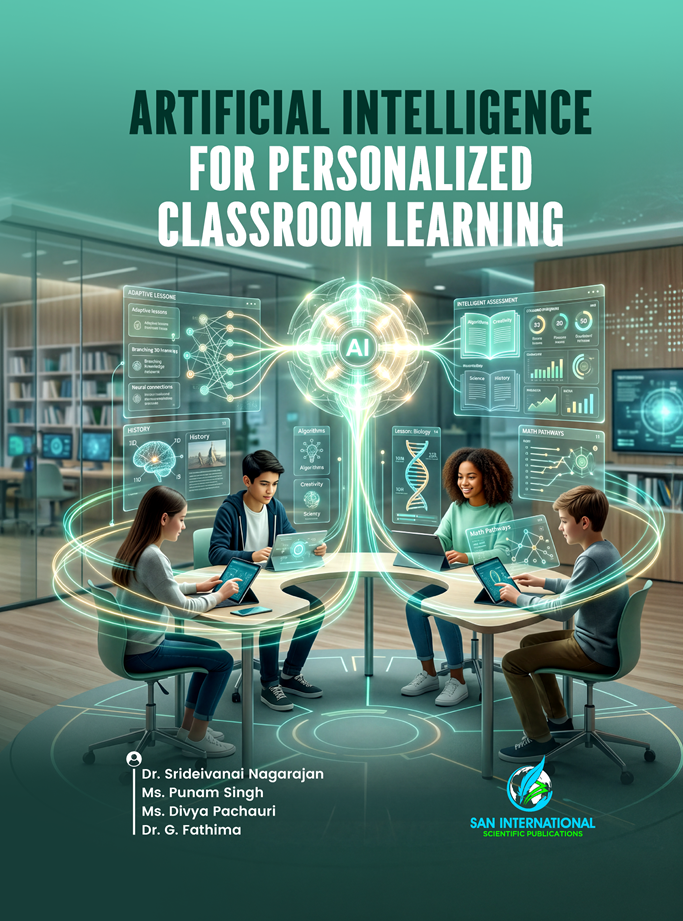
Artificial Intelligence for Personalized Classroom Learning
Authors: Dr. Srideivanai Nagarajan, Ms. Punam Singh, Ms. Divya Pachauri, and Dr. G. Fathima
ISBN: 978-81-69857-01-7
DOI: https://doi.org/10.59646/753
Date of Publication: July 08, 2026
Cite this book: Srideivanai N, Punam S, Divya P, and G. Fathima, (2026), Artificial Intelligence for Personalized Classroom Learning, San International Scientific Publications, ISBN: 978-81-69857-01-7, DOI: https://doi.org/10.59646/753
Preface
Education is undergoing one of the most profound transformations in its history. The rapid advancement of Artificial Intelligence (AI), big data analytics, cloud computing, and intelligent educational technologies has shifted the focus of learning from standardized instruction to highly personalized educational experiences. Traditional classrooms, designed around a uniform curriculum and fixed instructional pace, are increasingly being complemented by intelligent systems capable of adapting to the unique learning needs, abilities, interests, and aspirations of every student. This evolution represents a paradigm shift in education, where learning is no longer constrained by one-size-fits-all approaches but is instead driven by individualized pathways that maximize learner engagement, academic achievement, and lifelong success. Artificial Intelligence for Personalized Classroom Learning has been developed to provide a comprehensive understanding of this educational revolution by integrating the pedagogical foundations of personalized learning with the latest advancements in artificial intelligence.
Artificial Intelligence has emerged as one of the most influential technologies shaping twenty-first-century education. Machine learning algorithms, intelligent tutoring systems, natural language processing, adaptive assessment platforms, recommendation engines, predictive analytics, and conversational AI have enabled educators to design learning environments that continuously respond to the needs of individual learners. These technologies analyze diverse forms of educational data to identify learning patterns, predict performance, recommend appropriate instructional resources, provide real-time feedback, and support evidence-based decision-making. Rather than replacing teachers, AI empowers educators by automating routine tasks, offering meaningful learning insights, and enabling them to devote greater attention to mentoring, creativity, collaboration, and higher-order cognitive development.
This book has been carefully structured to guide readers through every major dimension of AI-driven personalized education. It begins by introducing the principles of personalized learning, student-centered pedagogy, adaptive instruction, and learning analytics before exploring the psychological foundations of learning, including cognitive theories, motivation, self-directed learning, and multiple intelligences. Building upon these educational principles, the book presents the core technologies that enable intelligent learning environments, including machine learning, intelligent tutoring systems, adaptive learning platforms, natural language processing, recommendation systems, and educational data mining. Each topic is presented in a manner that connects theoretical foundations with practical classroom implementation, enabling readers to understand not only how these technologies function but also how they improve educational outcomes.
A major strength of this book lies in its emphasis on practical classroom applications. Dedicated chapters explore AI-assisted instructional methods, collaborative learning environments, adaptive assessment systems, competency-based evaluation, automated grading, intelligent feedback mechanisms, and AI-supported skill development. The discussion extends beyond academic performance to include learner motivation, engagement, creativity, communication, collaboration, and problem-solving, reflecting the broader competencies required in contemporary education.
Throughout the book, emphasis is placed on maintaining a balanced partnership between human expertise and intelligent technologies, recognizing that meaningful education depends upon both technological innovation and compassionate teaching. The book also acknowledges that true personalization must be inclusive, equitable, and accessible to every learner. Comprehensive discussions address the use of AI technologies for students with disabilities, multilingual education, culturally responsive teaching, inclusive curriculum design, accessibility standards, and strategies for bridging the digital divide. These chapters demonstrate how intelligent educational systems can reduce learning barriers and create opportunities for students from diverse linguistic, cultural, social, and economic backgrounds. By promoting equity alongside innovation, the book reinforces the principle that technological advancement should expand educational opportunities rather than deepen existing inequalities.
As artificial intelligence becomes increasingly embedded within educational ecosystems, ethical considerations assume critical importance. Accordingly, this volume examines issues related to data privacy, cybersecurity, informed consent, algorithmic fairness, transparency, explainability, academic integrity, institutional governance, and responsible AI adoption. Readers are encouraged to critically evaluate both the opportunities and limitations of AI-powered education while developing an ethical framework for deploying intelligent technologies in schools, colleges, universities, and lifelong learning environments. Such discussions prepare educators, policymakers, and researchers to implement AI responsibly while safeguarding learner rights, trust, and educational integrity.
Looking toward the future, the book explores emerging innovations including intelligent classrooms, virtual and augmented reality, digital twins, lifelong learning systems, AI-powered educational ecosystems, global collaborative learning platforms, and human-AI partnerships that are expected to redefine educational practice in the coming decades. These developments highlight the transition from reactive educational systems to predictive, adaptive, and continuously evolving learning environments capable of supporting personalized education throughout an individual’s lifetime.
This book is intended to serve as a valuable resource for undergraduate and postgraduate students, teacher educators, educational technologists, researchers, instructional designers, school administrators, policymakers, software developers, and professionals working in artificial intelligence, educational technology, and digital learning. Its interdisciplinary approach combines educational theory, cognitive science, computer science, learning analytics, data science, and classroom practice to provide readers with both conceptual understanding and practical guidance for implementing AI-driven personalized learning.
It is our sincere hope that Artificial Intelligence for Personalized Classroom Learning will inspire educators to embrace innovation with responsibility, encourage researchers to advance evidence-based educational technologies, and empower institutions to create learning environments that recognize the uniqueness of every learner. By bringing together pedagogy, artificial intelligence, and human-centered education, this book aspires to contribute to the development of intelligent classrooms that are adaptive, inclusive, ethical, and capable of preparing future generations for a rapidly changing world.