
Machine Learning: Concepts, Techniques, and Real-World Systems
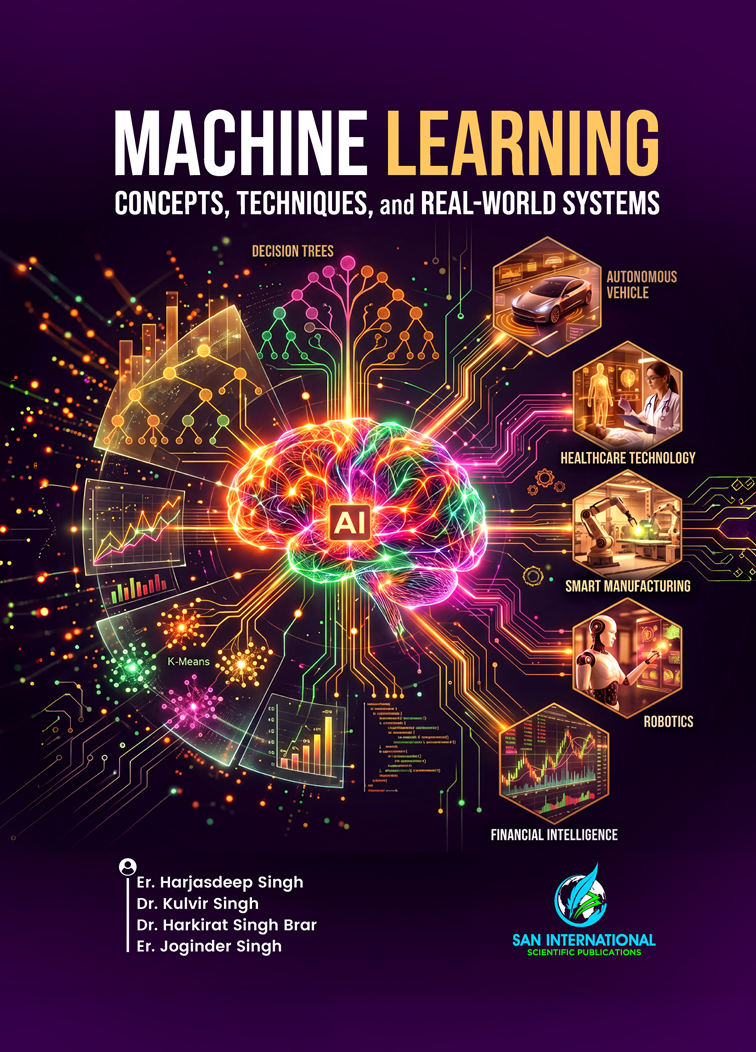
Machine Learning: Concepts, Techniques, and Real-World Systems
Authors: Er. Harjasdeep Singh, Dr. Kulvir Singh, Dr. Harkirat Singh Brar, and Er. Joginder Singh
ISBN: 978-81-687619-5-7
DOI: https://doi.org/10.59646/731
Date of Publication: June 17, 2026
Cite this book: Harjasdeep S, Kulvir S, Harkirat SB, and Joginder S, (2026), Machine Learning: Concepts, Techniques, and Real-World Systems, San International Scientific Publications, ISBN: 978-81-687619-5-7, DOI: https://doi.org/10.59646/731
Preface
Machine Learning has emerged as one of the most transformative technologies of the twenty-first century, revolutionizing the way individuals, organizations, and societies interact with data, make decisions, and solve complex problems. From personalized recommendations on digital platforms and intelligent healthcare diagnostics to autonomous vehicles and advanced cybersecurity systems, machine learning is driving innovation across virtually every sector of the global economy. As data continues to grow in volume, variety, and velocity, the ability to design systems that can learn from experience and improve their performance without explicit programming has become a critical skill for students, researchers, engineers, and industry professionals alike.
The book “Machine Learning: Concepts, Techniques, and Real-World Systems” has been carefully designed to provide a comprehensive, structured, and application-oriented understanding of machine learning. It bridges the gap between theoretical foundations and practical implementation by presenting core concepts, mathematical principles, algorithmic techniques, and real-world applications in a clear and systematic manner. The content is organized to guide readers from the fundamentals of machine learning to advanced learning paradigms that are shaping the future of artificial intelligence.
The book begins with an introduction to machine learning, exploring its key characteristics, learning paradigms, workflows, applications, and challenges. A strong emphasis is placed on understanding the role of data, model development, and evaluation processes that form the foundation of successful machine learning systems. Recognizing that mathematical literacy is essential for mastering machine learning, the second unit provides detailed coverage of linear algebra, probability theory, statistical inference, optimization methods, regularization techniques, and evaluation metrics that underpin modern algorithms.
Subsequent units focus on supervised learning methods, including regression and classification techniques. Readers are introduced to linear and polynomial regression, regularized models, decision trees, k-nearest neighbors, Naïve Bayes classifiers, support vector machines, ensemble methods, and model validation strategies. Practical case studies and real-world examples demonstrate how these algorithms can be applied to solve problems in healthcare, finance, retail, education, and other domains.
The book also explores unsupervised learning, covering clustering methods, dimensionality reduction techniques, and association rule mining. Concepts such as k-means clustering, hierarchical clustering, PCA, SVD, ICA, t-SNE, and Apriori algorithms are explained with a focus on both theoretical understanding and practical applications. These techniques enable organizations to uncover hidden patterns, discover insights, and create value from large and complex datasets. Recognizing the rapid evolution of the field, the final unit extends beyond traditional supervised and unsupervised learning to discuss emerging paradigms such as semi-supervised learning, self-supervised learning, transfer learning, active learning, online learning, multi-task learning, and meta-learning. These approaches represent the next generation of intelligent systems capable of learning efficiently from limited data, adapting to new tasks, and continuously improving in dynamic environments.
Throughout the book, emphasis has been placed on conceptual clarity, mathematical rigor, practical relevance, and real-world applicability. Each topic has been organized in a logical sequence to support progressive learning, making the text suitable for undergraduate and postgraduate students, educators, researchers, and professionals seeking a solid foundation in machine learning. By integrating theory with applications and case studies, this book aims to develop both analytical understanding and problem-solving skills required in modern data-driven environments.
It is our sincere hope that this book will serve as a valuable resource for learners embarking on their machine learning journey and for practitioners seeking to deepen their expertise. As machine learning continues to reshape industries and society, a strong understanding of its concepts, techniques, and systems will be essential for creating innovative, ethical, and impactful technological solutions for the future.