Emergency Management and Drug Safety Monitoring in AYUSH Systems
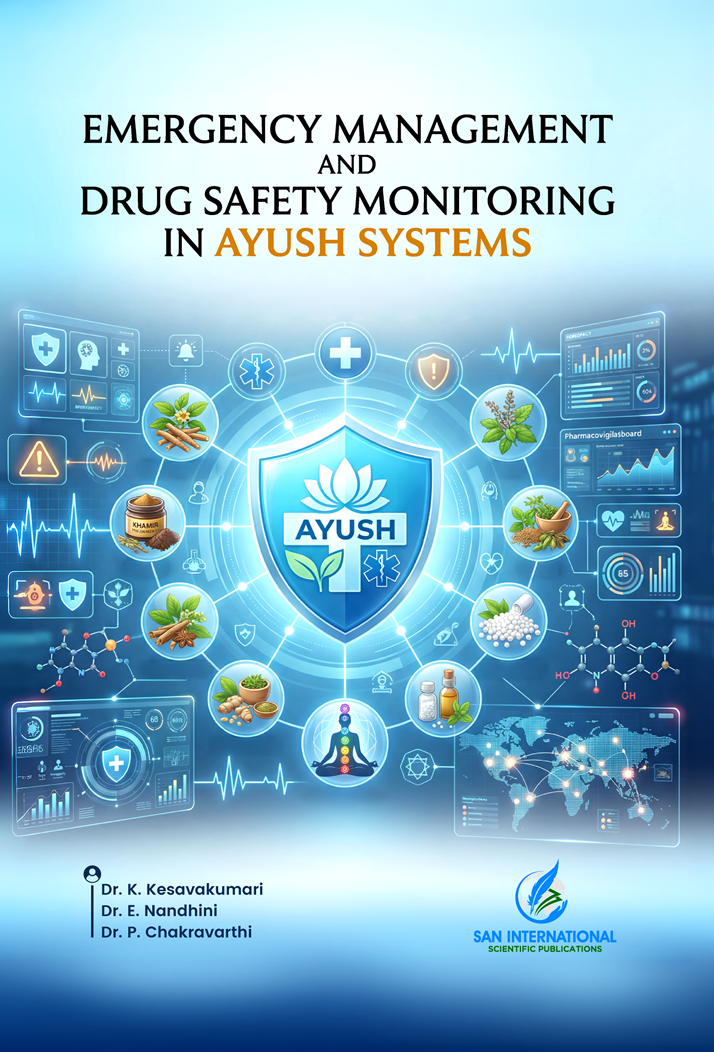
Emergency Management and Drug Safety Monitoring in AYUSH Systems
Authors: Dr. K. Kesavakumari, Dr. E. Nandhini, and Dr. P. Chakravarthi
ISBN: 978-81-69297-61-5
DOI: https://doi.org/10.59646/718
Date of Publication: June 05, 2026
Cite this book: K. Kesavakumari, E. Nandhini, and P. Chakravarthi, (2026), Emergency Management and Drug Safety Monitoring in AYUSH Systems, San International Scientific Publications, ISBN: 978-81-69297-61-5, DOI: https://doi.org/10.59646/718
Preface
The field of healthcare is constantly evolving in response to emerging diseases, increasing patient expectations, technological advancements, and the growing emphasis on patient safety. Within this dynamic environment, the AYUSH systems of medicine—Ayurveda, Yoga & Naturopathy, Unani, Siddha, and Homoeopathy—play a significant role in providing holistic, preventive, promotive, and therapeutic healthcare services. As the utilization of AYUSH therapies and medicines continues to expand globally, there is an increasing need for healthcare professionals to possess comprehensive knowledge not only of disease management but also of emergency care, patient stabilization, drug safety, pharmacovigilance, and toxicological evaluation. The book “Emergency Management and Drug Safety Monitoring in AYUSH Systems” has been developed to address these essential requirements and to provide students, practitioners, researchers, academicians, and healthcare administrators with a structured and comprehensive understanding of emergency medicine and pharmacovigilance within the context of AYUSH healthcare practices.
Medical emergencies can arise unexpectedly in any healthcare setting and require prompt recognition, accurate assessment, and timely intervention to prevent complications and save lives. Although AYUSH systems primarily emphasize preventive healthcare and holistic treatment approaches, practitioners frequently encounter acute medical conditions, trauma cases, poisoning incidents, allergic reactions, adverse drug events, and situations requiring immediate clinical decision-making. Therefore, understanding the principles of emergency medicine, patient stabilization, airway management, shock recognition, trauma care, and disaster response has become an indispensable component of modern AYUSH clinical practice. Equally important is the ability to identify clinical warning signs, interpret diagnostic indicators, and coordinate appropriate referral and multidisciplinary care whenever necessary.
In parallel with emergency management, the safety monitoring of medicines has emerged as a critical area of healthcare practice. Pharmacovigilance has become a cornerstone of patient safety by ensuring the detection, assessment, understanding, and prevention of adverse effects associated with medicinal products. The growing use of herbal medicines, mineral preparations, traditional formulations, and integrative treatment approaches has highlighted the need for robust pharmacovigilance systems specifically tailored to AYUSH medicines. Healthcare professionals must be equipped with the knowledge and skills required to identify adverse drug reactions, assess causality, evaluate drug interactions, monitor toxicological risks, and contribute effectively to national and international drug safety surveillance programs. This book seeks to bridge the gap between traditional therapeutic knowledge and modern pharmacovigilance principles, thereby strengthening the safe and rational use of AYUSH medicines.
The structure of this book has been carefully designed to provide a progressive learning experience. The initial units focus on the foundations of emergency medicine, including emergency patient evaluation, acute care principles, physiological responses to illness and trauma, airway-breathing-circulation assessment, and stabilization procedures. Subsequent units explore emergency assessment techniques, diagnostic interpretation, and the management of cardiovascular, respiratory, neurological, metabolic, infectious, renal, and gastrointestinal emergencies. Special emphasis is placed on trauma care, toxicology, hemorrhage control, fracture stabilization, burn management, poisoning, envenomation, and disaster response systems, reflecting the broad spectrum of emergencies that healthcare professionals may encounter in clinical practice.
The latter part of the book is dedicated to pharmacovigilance and drug safety monitoring. Detailed discussions are presented on the foundations of pharmacovigilance science, adverse drug reaction reporting systems, causality assessment methodologies, signal detection techniques, drug-event association analysis, benefit-risk evaluation, and safety surveillance frameworks relevant to AYUSH medicines. The text further explores toxicological principles associated with herbal, mineral, and traditional formulations, including heavy metal toxicity, herb-drug interactions, quality-related adverse reactions, and post-marketing safety evaluation. Advanced chapters introduce modern approaches such as active and passive surveillance systems, pharmacoepidemiologic study designs, clinical database analysis, real-world evidence generation, data mining techniques, signal validation, and pharmacovigilance research methodologies, thereby preparing readers for contemporary challenges in healthcare monitoring and regulatory science.
A distinguishing feature of this book is its integrative approach that combines traditional AYUSH principles with evidence-based clinical practices, patient safety frameworks, and modern healthcare regulations. The content has been developed with a strong emphasis on practical applicability, critical thinking, clinical decision-making, and ethical responsibility. It aims to cultivate a culture of vigilance, accountability, and patient-centered care among future healthcare professionals while encouraging scientific evaluation and continuous quality improvement within AYUSH systems.
It is hoped that this book will serve as a valuable academic resource and professional reference for undergraduate and postgraduate students, faculty members, clinicians, pharmacovigilance professionals, researchers, and policymakers involved in AYUSH healthcare. By strengthening competencies in emergency management and drug safety monitoring, the book aspires to contribute to improved patient outcomes, enhanced healthcare quality, and the advancement of safe, effective, and evidence-informed AYUSH practice. Ultimately, the integration of emergency preparedness and pharmacovigilance into AYUSH education and clinical care represents a vital step toward achieving excellence in holistic healthcare and ensuring the well-being of patients in an increasingly complex healthcare environment.