
Sushasanama: Decoding Nitish Kumar’s Model of Good Governance
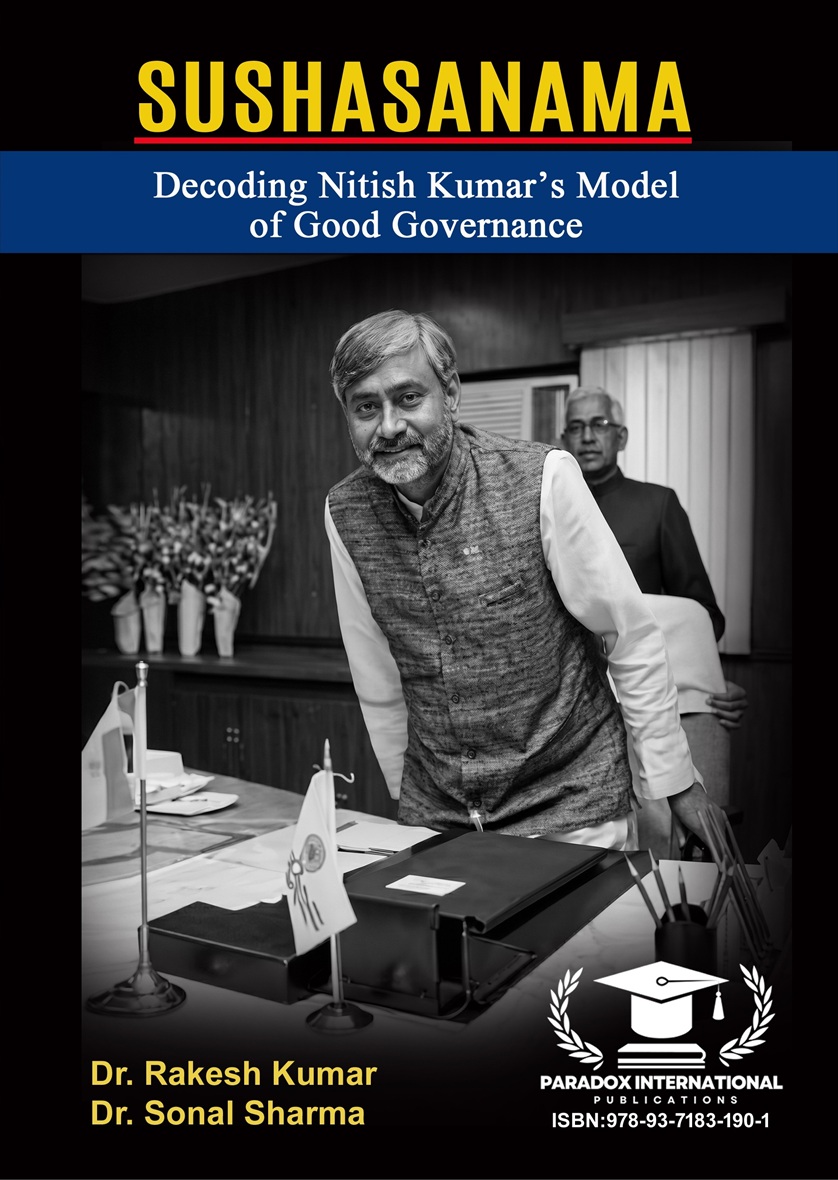
Sushasanama: Decoding Nitish Kumar’s Model of Good Governance
Authors: Dr. Rakesh Kumar, and Dr. Sonal Sharma
ISBN: 978-93-7183-190-1
DOI: https://doi.org/10.59646/666
Date of Publication: April 15, 2026
Cite this book: Rakesh K, and Sonal S, (2026), Sushasanama: Decoding Nitish Kumar’s Model of Good Governance, Paradox International Publications & San International Scientific Publications, ISBN: 978-93-7183-190-1, DOI: https://doi.org/10.59646/666
Preface
The idea of “Sushasan”—good governance—has long been central to the discourse on public administration and political leadership in India. Among contemporary political leaders, Nitish Kumar stands out as a figure whose governance model has been widely discussed, debated, and analyzed under this very framework. This book, “Sushasanama: Decoding Nitish Kumar’s Model of Good Governance,” seeks to critically examine the principles, policies, and practices that shaped what came to be popularly known as the “Sushasan Model.”
Emerging in the early 2000s, this model was rooted in a context where governance challenges—particularly in states like Bihar—were profound. Issues of weak law and order, infrastructural deficits, and socio-economic stagnation necessitated a shift toward a governance paradigm that prioritized administrative efficiency, transparency, and inclusive development. Nitish Kumar’s tenure, especially since 2005, marked a significant departure from earlier governance patterns, focusing on rebuilding institutional credibility and restoring public trust. This book explores how governance reforms under his leadership emphasized infrastructure development, improvements in law enforcement, and social welfare initiatives such as educational incentives and gender empowerment schemes. These measures contributed to reshaping the developmental narrative of Bihar and earned him the moniker “Sushasan Babu,” symbolizing a commitment to good governance.
However, governance is rarely linear or uncontested. The Nitish Kumar model has also been subject to scrutiny, particularly in areas such as policy consistency, political realignments, and evolving socio-economic outcomes. The book does not merely celebrate achievements but engages in a balanced analysis—highlighting both successes and limitations. It situates the “Sushasan Model” within broader debates on governance, federalism, political adaptability, and development economics.
Sushasanama is structured to provide a comprehensive understanding of governance through multiple lenses—historical evolution, administrative reforms, social policy innovations, and political strategy. It integrates theoretical insights with empirical observations, making it relevant for students, researchers, policymakers, and practitioners in the fields of public administration, political science, and development studies. At its core, this book aims to answer a fundamental question: Can the principles of the “Sushasan Model” be replicated across different regions, or are they inherently shaped by the socio-political fabric of Bihar? By addressing this, the book contributes to a deeper understanding of governance as both a science and an art—one that evolves with context, leadership, and institutional dynamics. This work aspires to stimulate critical thinking and informed debate, encouraging readers to move beyond simplistic narratives and engage with governance as a complex, dynamic, and ever-evolving phenomenon.