
Artificial Minds and Future Machines: Redefining Human–Computer Interaction
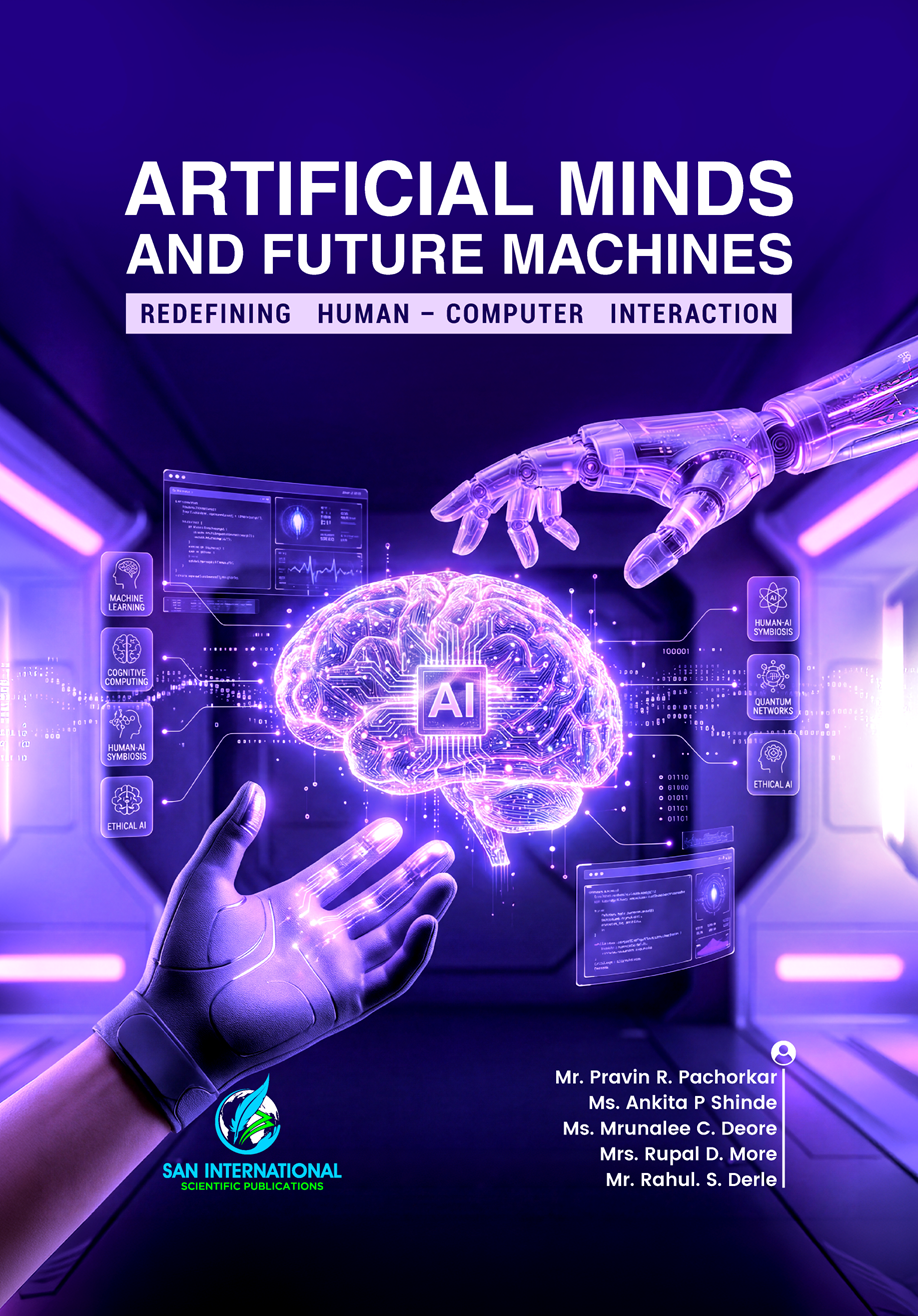
Artificial Minds and Future Machines: Redefining Human–Computer Interaction
Authors: Mr. Pravin R. Pachorkar, Ms. Ankita P Shinde, Ms. Mrunalee C. Deore, Mrs. Rupal D. More, and Mr. Rahul. S. Derle
ISBN: 978-81-69297-40-0
DOI: https://doi.org/10.59646/636
Date of Publication: March 25, 2026
Cite this book: Pravin RP, Ankita PS, Mrunalee CD, Rupal DM, and Rahul SD, Artificial Minds and Future Machines: Redefining Human–Computer Interaction, San International Scientific Publications, ISBN: 978-81-69297-40-0, DOI: https://doi.org/10.59646/636
Preface
The rapid evolution of artificial intelligence marks not just a technological milestone, but a fundamental transformation in the relationship between humans and machines—one that reshapes cognition, creativity, communication, and even the essence of human identity. Artificial Minds and Future Machines: Redefining Human–Computer Interaction presents a comprehensive exploration of this transformation, guiding readers through the conceptual, technical, and philosophical foundations of artificial minds and their growing role in society. Beginning with the origins of symbolic AI and extending into modern cognitive computing systems, the book examines how machines have progressed from executing predefined commands to exhibiting forms of learning, reasoning, perception, and adaptive behavior that increasingly resemble human thought processes. It delves deeply into the evolution of human–computer interaction, highlighting the shift from static interfaces to dynamic, context-aware, and conversational systems that can interpret language, emotion, gesture, and intent. By integrating insights from computational neuroscience, cognitive architectures, and machine perception, the text illuminates how artificial systems model human cognition and where they diverge, offering critical comparative perspectives on natural and synthetic intelligence. Furthermore, it explores emerging domains such as affective computing, generative intelligence, cognitive robotics, and brain–computer interfaces, revealing how machines are becoming not only intelligent but also emotionally responsive and creatively expressive. The book also addresses the ethical, psychological, and societal implications of these advancements, including questions of trust, autonomy, bias, and the illusion of machine empathy, while emphasizing the importance of responsible and human-centered design. Structured across a progressive framework of themes—from foundational theories to future visions of symbiotic intelligence and digital co-evolution —this work ultimately challenges readers to rethink the boundaries between human and machine, envisioning a future where interaction is seamless, intelligence is shared, and the distinction between biological and artificial cognition becomes increasingly blurred in a deeply interconnected digital world.