Catalysts for Change: The Science Behind Green Chemistry
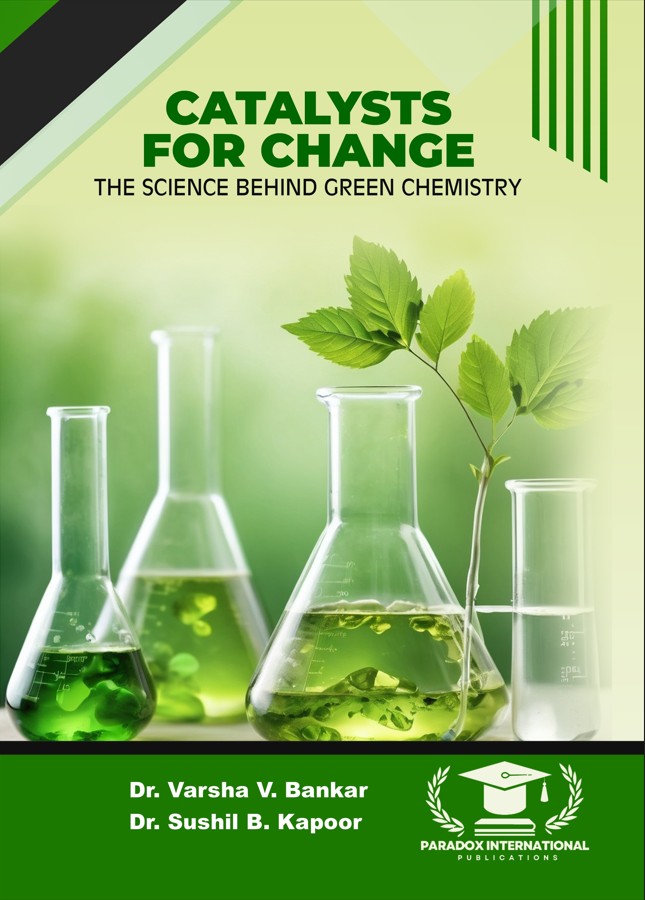
Catalysts for Change: The Science Behind Green Chemistry
Authors: Dr. Varsha V. Bankar, and Dr. Sushil B. Kapoor
ISBN: 978-93-7183-053-9
DOI: https://doi.org/10.59646/553
Date of Publication: December 31, 2025
About the Book:
In an era marked by unprecedented environmental challenges and an urgent imperative for sustainable solutions, green chemistry has emerged as a transformative field that reimagines how chemicals are designed, produced, and utilized. At the heart of this transformation lies catalysis—the science and practice of accelerating chemical reactions with minimal energy input, maximal efficiency, and reduced ecological harm. Catalysts for Change: The Science Behind Green Chemistry seeks to provide a comprehensive and accessible exploration of this dynamic intersection between catalysis and sustainability.
This textbook has been conceived with a dual purpose: to introduce students, researchers, and practitioners to the foundational principles of green chemistry, and to illustrate how catalytic science serves as a critical enabler of environmentally responsible chemical processes. While green chemistry encompasses a broad set of strategies aimed at reducing pollution and conserving resources, catalysis is uniquely positioned to drive innovation by improving reaction efficiency, enhancing selectivity, and minimizing waste. By advancing catalytic techniques and understanding their underlying mechanisms, chemists and engineers can design processes that are not only technically effective but also environmentally benign. The content of this book reflects a careful balance between theory and application. Beginning with the historical evolution of green chemistry, we emphasize the philosophical and ethical context that motivates modern sustainable practices. Subsequent chapters delve into the fundamental science of catalysis, exploring both homogeneous and heterogeneous systems, biocatalysis, and emerging catalytic technologies such as photocatalysis and electrocatalysis. Throughout the text, case studies and real-world examples demonstrate how catalytic strategies are being implemented in areas as diverse as pharmaceutical synthesis, renewable energy, pollution control, and industrial manufacturing.
Several features distinguish this textbook from others in the field. First, the material is presented in a way that supports learners at various levels—from undergraduates encountering green chemistry for the first time to graduate students and professionals seeking deeper insights. Clear explanations, illustrative figures, and thoughtfully designed problems encourage analytical thinking and practical comprehension. Second, the book emphasizes sustainability metrics and life cycle perspectives, equipping readers with tools to critically assess the environmental impact of chemical processes. Finally, by integrating discussions of policy, economics, and ethical considerations, this text reinforces the notion that scientific innovation must be aligned with broader societal goals. The development of this book would not have been possible without the guidance and contributions of many colleagues and reviewers who provided valuable feedback during its preparation. We are also grateful to the numerous researchers whose pioneering work in catalysis and green chemistry has laid the foundation for the ideas presented here. As the chemical sciences continue to evolve, the role of catalysis in driving sustainable innovation will only grow in significance. It is our hope that this textbook will serve as both a comprehensive reference and an inspiration for future scientists committed to advancing a cleaner, safer, and more sustainable world.