Political Theory: Classical Foundations and Contemporary Issues
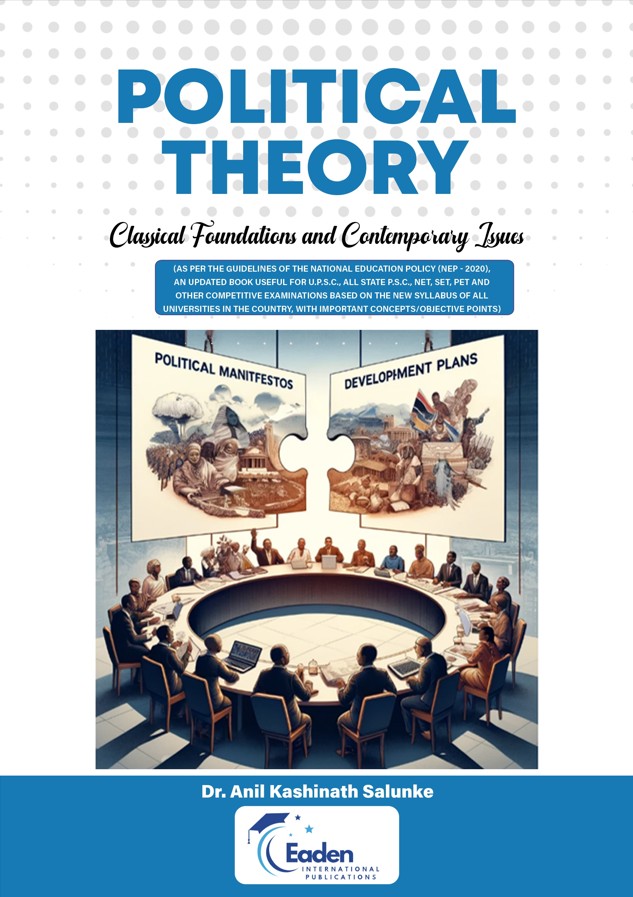
Political Theory: Classical Foundations and Contemporary Issues
Author: Dr. Anil Kashinath Salunke
ISBN: 978-81-994205-1-9
DOI: https://doi.org/10.59646/486
Date of Publication: October 07, 2025
About the Book:
Political theory has always served as the intellectual compass of political life, guiding societies in their search for justice, order, liberty, and the good life. From the dialogues of Plato to the reflections of contemporary thinkers on democracy, globalization, and identity, the discipline continues to shape the way we understand politics and its role in human affairs. This textbook, Political Theory: Classical Foundations and Contemporary Issues, is an effort to bridge the rich legacy of classical thought with the pressing challenges of the modern world.
The first part of the book introduces students to the classical foundations of political theory by revisiting the ideas of seminal thinkers such as Plato, Aristotle, Machiavelli, Hobbes, Locke, Rousseau, and Marx. Their debates on authority, power, rights, and justice not only laid the groundwork of modern political science but also remain relevant to the dilemmas of governance today.
The second part turns to contemporary issues, engaging with themes such as democracy and its crises, human rights, feminism, multiculturalism, environmental justice, and the politics of globalization. These chapters highlight how classical debates evolve and acquire new meanings in light of current realities, offering students both continuity and innovation in their understanding of politics.
Designed for undergraduate and postgraduate students of political science, this book emphasizes clarity, accessibility, and critical engagement. Each chapter includes guiding questions, key terms, and suggestions for further reading, encouraging readers to reflect, analyze, and debate rather than passively absorb information.
In writing this text, the aim has been to create a balance between historical depth and contemporary relevance. Political theory is not a relic of the past; it is a living discourse that challenges us to think rigorously about the principles that govern collective life. It is my hope that this book will inspire students to see political theory not merely as an academic subject but as a vital resource for democratic citizenship and responsible engagement in the world.