Theory and Mechanism in Novel Drug Delivery Technologies
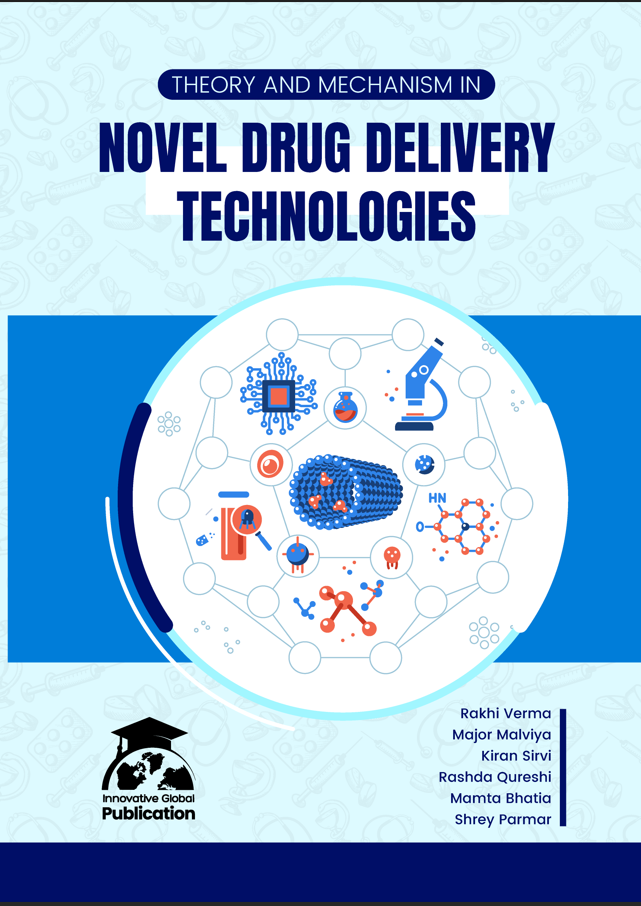
Theory and Mechanism in Novel Drug Delivery Technologies
Authors: Rakhi Verma, Major Malviya, Kiran Sirvi, Rashda Qureshi, Mamta Bhatia, Shrey Parmar
ISBN: 978-81-989856-4-4
DOI: https://doi.org/10.59646/ddt/400
Date of Publication: July 07, 2025
About the Book:
In the dynamic landscape of pharmaceutical sciences, the delivery of therapeutic agents has evolved beyond traditional methods to embrace sophisticated, precise, and patient-centered strategies. This academic endeavor, Theory and Mechanism in Novel Drug Delivery Technologies, emerges as a collaborative scholarly effort by five authors united by a shared passion for innovation in drug delivery systems. The book is meticulously designed to provide a comprehensive understanding of both foundational principles and the latest technological advancements in this fast-growing domain.
The pharmaceutical industry has witnessed a paradigm shift with the convergence of material science, nanotechnology, biotechnology, and computational intelligence. These intersections have revolutionized the development of drug carriers, enhanced site-specific delivery, and improved the pharmacokinetic and pharmacodynamic profiles of therapeutic agents. With this transformation in mind, the present book serves as both a theoretical guide and a practical reference for students, researchers, and professionals involved in drug formulation and delivery research.
The book is structured into twelve systematically curated units, each designed to progressively build the reader’s understanding from fundamental concepts to advanced applications.
Unit I sets the stage by detailing the Fundamentals of Drug Delivery Systems, offering insights into historical developments, classifications, and regulatory frameworks. Unit II explores the Mechanisms of Drug Transport, including passive and active mechanisms that dictate drug movement across biological barriers.
Building on this base, Unit III and Unit IV delve into specialized systems—Polymeric and Lipid-Based Drug Delivery Systems, respectively—highlighting their design principles, material science, and real-world applications. Unit V addresses Nanotechnology in Drug Delivery, a field that holds immense promise for precision medicine, through an in-depth look at nanocarriers, targeting strategies, and bio-interactions.
Unit VI focuses on Targeted Drug Delivery Systems, examining strategies like ligand-receptor interactions and stimuli-responsive delivery. Units VII and VIII pivot toward site-specific approaches such as Transdermal, Topical, and Oral Controlled and Colon Targeted Delivery, with practical examples and current formulations in therapeutic use.
Expanding the scope, Unit IX introduces Pulmonary and Nasal Drug Delivery, elucidating the anatomical and technical aspects of drug administration through respiratory pathways. Unit X presents Parenteral and Implantable Systems, which offer sustained and long-acting therapeutic benefits through innovative formulations and devices.
Unit XI explores the transformative field of Gene and Nucleic Acid-Based Delivery, examining tools like siRNA and CRISPR systems, with a balanced discussion on safety and ethical considerations. Finally, Unit XII gazes into the future, surveying Emerging Technologies and Trends including AI-driven drug design, 3D printing, theranostics, and sustainable delivery systems.
As co-authors, we bring together our diverse academic and research experiences to bridge theoretical knowledge with current and emerging applications. This book reflects a collaborative vision to make drug delivery science accessible, relevant, and engaging. We hope it inspires new inquiries and solutions in the pursuit of safer, more effective, and patient-friendly therapeutic delivery platforms.
We extend our sincere gratitude to our academic mentors, colleagues, and research communities for their continued guidance and collaboration. Most importantly, we are indebted to our readers—students, educators, and practitioners—whose curiosity and commitment to innovation in pharmaceutical sciences drive the very evolution this book seeks to illuminate.